


Page 73 - MAT KS3 Y8 Cambridge CheckPoint
P. 73
7.1 Finding equivalent fractions, decimals and percentages


               7.1 Finding equivalent fractions, decimals and percentages


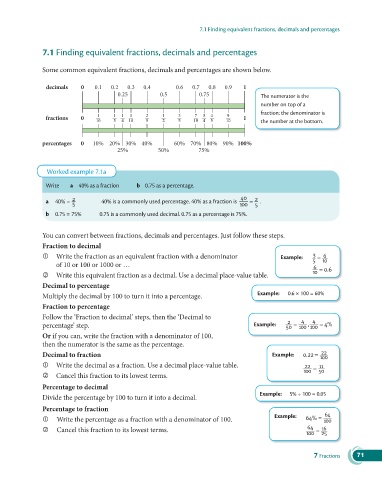
               Some common equivalent fractions, decimals and percentages are shown below.


                decimals    0    0.1  0.2   0.3  0.4        0.6  0.7   0.8  0.9   1
                                        0.25          0.5          0.75                 The numerator is the
                                                                                        number on top of a
                                                                                        fraction; the denominator is
                                 1     1  1  3    2    1     3    7  3  4    9
                fractions   0                                                     1
                                 10    5  4  10   5    2     5    10 4  5   10          the number at the bottom.

               percentages  0   10% 20% 30% 40%            60% 70% 80% 90% 100%
                                        25%           50%          75%


                 Worked example 7.1a

                Write   a  40% as a fraction   b  0.75 as a percentage.

                                                                                 40
                         2
                a 40% =            40% is a commonly used percentage. 40% as a fraction is   100  =  2  .
                         5
                                                                                      5
                b  0.75 = 75%     0.75 is a commonly used decimal. 0.75 as a percentage is 75%.
               You can convert between fractions, decimals and percentages. Just follow these steps.

               Fraction to decimal
               c  Write the fraction as an equivalent fraction with a denominator              Example:   3  =  6
                                                                                                         5   10
                    of 10 or 100 or 1000 or …                                                             6
                                                                                                              .
                                                                                                         10  =  06
               d  Write this equivalent fraction as a decimal. Use a decimal place-value table.
               Decimal to percentage
               Multiply the decimal by 100 to turn it into a percentage.               Example:   0.6 × 100 = 60%
               Fraction to percentage
               Follow the ‘Fraction to decimal’ steps, then the ‘Decimal to
                                                                                                      4
                                                                                                         4
                                                                                                 2
                                                                                                        ,
               percentage’ step.                                                      Example:   50  =  100 100  =  4%
               Or if you can, write the fraction with a denominator of 100,
               then the numerator is the same as the percentage.
                                                                                                       .
               Decimal to fraction                                                          Example:   022 =  22
                                                                                                            100
               c  Write the decimal as a fraction. Use a decimal place-value table.                    22  =  11
                                                                                                      100  50
               d Cancel this fraction to its lowest terms.
               Percentage to decimal
                                                                                        Example:   5% ÷ 100 = 0.05
               Divide the percentage by 100 to turn it into a decimal.
               Percentage to fraction
                                                                                             Example:   64% =  64
               c  Write the percentage as a fraction with a denominator of 100.                              100
               d Cancel this fraction to its lowest terms.                                              64  =  16
                                                                                                       100  25


                                                                                                          7 Fractions   71

