


Page 68 - MAT KS3 Y8 Cambridge CheckPoint
P. 68
6.3 Using frequency tables


               6.3 Using frequency tables


               You can use frequency tables with equal class intervals to gather continuous data.
               A frequency table has three columns. The first column lists the
                                                                             When you use a frequency table with
               class intervals, the second is for recording the tally marks and
                                                                             tallies, make sure the tally column is
               the third is for the frequency.
                                                                             wide enough for lots of results.
               To describe the class intervals, you can use these symbols:
                     <  which means ‘less than’
               and     which means ‘less than or equal to’.
               Examples:   The class 63 kg < m   65 kg means any mass (w) from 63 kg, but not including 63 kg,
                           up to and including a mass of 65 kg.
                             The class 63 kg   m < 65 kg means any mass (w) from 63 kg, including 63 kg, up
                           to but not including a mass of 65 kg.

                 Worked example 6.3a

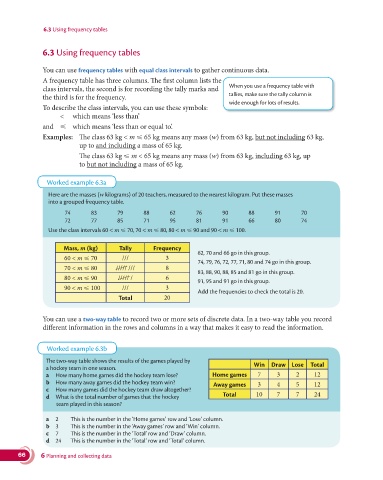
                   Here are the masses (w kilograms) of 20 teachers, measured to the nearest kilogram. Put these masses
                  into a grouped frequency table.
                       74      83       79       88       62      76       90       88       91      70
                       72      77       85       71       95      81       91       66       80      74
                  Use the class intervals 60 < m   70, 70 < m   80, 80 < m   90 and 90 < m   100.


                      Mass, m (kg)       Tally      Frequency
                                                                   62, 70 and 66 go in this group.
                      60 < m   70         ///           3
                                                                   74, 79, 76, 72, 77, 71, 80 and 74 go in this group.
                      70 < m   80       ///// ///       8
                                                                   83, 88, 90, 88, 85 and 81 go in this group.
                      80 < m   90       ///// /         6
                                                                   91, 95 and 91 go in this group.
                       90 < m   100       ///           3
                                                                   Add the frequencies to check the total is 20.
                                         Total          20


               You can use a two-way table to record two or more sets of discrete data. In a two-way table you record
               different information in the rows and columns in a way that makes it easy to read the information.


                 Worked example 6.3b

                The two-way table shows the results of the games played by
                a hockey team in one season.                                          Win Draw Lose      Total
                a  How many home games did the hockey team lose?        Home games     7     3      2     12
                b  How many away games did the hockey team win?         Away games     3     4      5     12
                c  How many games did the hockey team draw altogether?
                d  What is the total number of games that the hockey       Total      10     7      7     24
                    team played in this season?

                a  2     This is the number in the ‘Home games’ row and ‘Lose’ column.
                b  3     This is the number in the ‘Away games’ row and ‘Win’ column.
                c  7     This is the number in the ‘Total’ row and ‘Draw’ column.
                d  24    This is the number in the ‘Total’ row and ‘Total’ column.

       66      6 Planning and collecting data

