


Page 530 - Basic College Mathematics with Early Integers
P. 530
READING PICTOGRAPHS, BAR GRAPHS,                                       Objectives
            7.1 HISTOGRAMS, AND LINE GRAPHS
                                                                                            Read Pictographs.

            Often data are presented visually in a graph. In this section, we practice reading sev-  Read and Construct Bar Graphs.
            eral kinds of graphs, including pictographs, bar graphs, and line graphs.
                                                                                            Read and Construct Histograms.

            Objective      Reading Pictographs                                              Read Line Graphs.

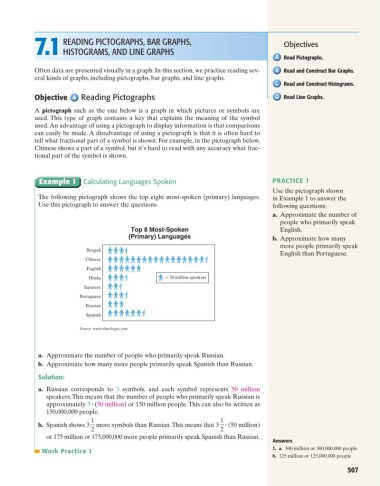
            A pictograph such as the one below is a graph in which pictures or symbols are
            used. This type of graph contains a key that explains the meaning of the symbol
            used.An advantage of using a pictograph to display information is that comparisons
            can easily be made. A disadvantage of using a pictograph is that it is often hard to
            tell what fractional part of a symbol is shown. For example, in the pictograph below,
            Chinese shows a part of a symbol, but it’s hard to read with any accuracy what frac-
            tional part of the symbol is shown.


             Example 1 Calculating Languages Spoken                                     PRACTICE 1
                                                                                        Use the pictograph shown
             The following pictograph shows the top eight most-spoken (primary) languages.  in Example 1 to answer the
             Use this pictograph to answer the questions.                               following questions:
                                                                                        a. Approximate the number of
                                                                                          people who primarily speak
                                           Top 8 Most-Spoken                              English.
                                          (Primary) Languages                           b. Approximate how many
                                                                                          more people primarily speak
                             Bengali
                                                                                          English than Portuguese.
                            Chinese
                             English
                             Hindu                     50 million speakers
                            Japanese
                          Portuguese
                            Russian
                            Spanish

                          Source: www.ethnologue.com


             a. Approximate the number of people who primarily speak Russian.
             b. Approximate how many more people primarily speak Spanish than Russian.

             Solution:
             a. Russian corresponds to  3 symbols, and each symbol represents  50 million
                speakers.This means that the number of people who primarily speak Russian is
                              #
                approximately 3 (50 million)  or 150 million people. This can also be written as
                150,000,000 people.
                              1                                        1
             b. Spanish shows 3   more symbols than Russian.This means that 3   #  (50 million)
                              2                                        2
                or 175 million or 175,000,000 more people primarily speak Spanish than Russian.
                                                                                        Answers
              Work Practice 1                                                           1. a. 300 million or 300,000,000 people
                                                                                        b. 125 million or 125,000,000 people
                                                                                                                507

