


Page 734 - Basic Electrical Engineering
P. 734
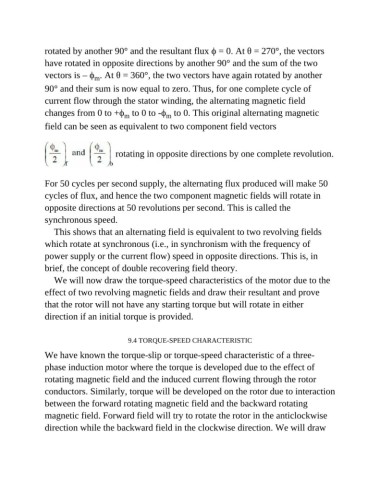
rotated by another 90° and the resultant flux ϕ = 0. At θ = 270°, the vectors
               have rotated in opposite directions by another 90° and the sum of the two
               vectors is – ϕ . At θ = 360°, the two vectors have again rotated by another
                               m
               90° and their sum is now equal to zero. Thus, for one complete cycle of

               current flow through the stator winding, the alternating magnetic field
               changes from 0 to +ϕ  to 0 to -ϕ  to 0. This original alternating magnetic
                                         m
                                                      m
               field can be seen as equivalent to two component field vectors


                                      rotating in opposite directions by one complete revolution.


               For 50 cycles per second supply, the alternating flux produced will make 50

               cycles of flux, and hence the two component magnetic fields will rotate in
               opposite directions at 50 revolutions per second. This is called the

               synchronous speed.
                  This shows that an alternating field is equivalent to two revolving fields
               which rotate at synchronous (i.e., in synchronism with the frequency of

               power supply or the current flow) speed in opposite directions. This is, in
               brief, the concept of double recovering field theory.

                  We will now draw the torque-speed characteristics of the motor due to the
               effect of two revolving magnetic fields and draw their resultant and prove

               that the rotor will not have any starting torque but will rotate in either
               direction if an initial torque is provided.


                                          9.4 TORQUE-SPEED CHARACTERISTIC

               We have known the torque-slip or torque-speed characteristic of a three-
               phase induction motor where the torque is developed due to the effect of

               rotating magnetic field and the induced current flowing through the rotor
               conductors. Similarly, torque will be developed on the rotor due to interaction

               between the forward rotating magnetic field and the backward rotating
               magnetic field. Forward field will try to rotate the rotor in the anticlockwise

               direction while the backward field in the clockwise direction. We will draw

