


Page 736 - Basic Electrical Engineering
P. 736
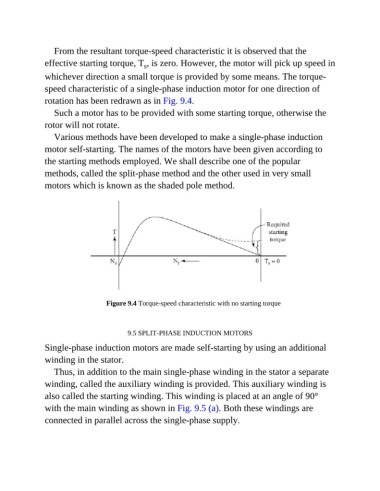
From the resultant torque-speed characteristic it is observed that the
               effective starting torque, T , is zero. However, the motor will pick up speed in
                                               s
               whichever direction a small torque is provided by some means. The torque-
               speed characteristic of a single-phase induction motor for one direction of

               rotation has been redrawn as in Fig. 9.4.
                  Such a motor has to be provided with some starting torque, otherwise the
               rotor will not rotate.

                  Various methods have been developed to make a single-phase induction
               motor self-starting. The names of the motors have been given according to

               the starting methods employed. We shall describe one of the popular
               methods, called the split-phase method and the other used in very small

               motors which is known as the shaded pole method.


                                   Figure 9.4 Torque-speed characteristic with no starting torque


                                          9.5 SPLIT-PHASE INDUCTION MOTORS
               Single-phase induction motors are made self-starting by using an additional

               winding in the stator.
                  Thus, in addition to the main single-phase winding in the stator a separate

               winding, called the auxiliary winding is provided. This auxiliary winding is
               also called the starting winding. This winding is placed at an angle of 90°

               with the main winding as shown in Fig. 9.5 (a). Both these windings are
               connected in parallel across the single-phase supply.

