


Page 735 - Basic Electrical Engineering
P. 735
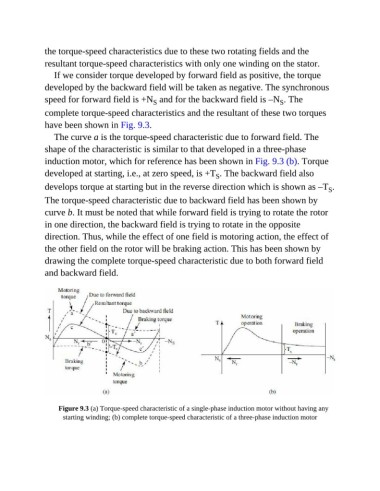
the torque-speed characteristics due to these two rotating fields and the
               resultant torque-speed characteristics with only one winding on the stator.
                  If we consider torque developed by forward field as positive, the torque

               developed by the backward field will be taken as negative. The synchronous
               speed for forward field is +N  and for the backward field is –N . The
                                                  S
                                                                                           S
               complete torque-speed characteristics and the resultant of these two torques
               have been shown in Fig. 9.3.

                  The curve a is the torque-speed characteristic due to forward field. The
               shape of the characteristic is similar to that developed in a three-phase

               induction motor, which for reference has been shown in Fig. 9.3 (b). Torque
               developed at starting, i.e., at zero speed, is +T . The backward field also
                                                                      S
               develops torque at starting but in the reverse direction which is shown as –T .
                                                                                                           S
               The torque-speed characteristic due to backward field has been shown by
               curve b. It must be noted that while forward field is trying to rotate the rotor
               in one direction, the backward field is trying to rotate in the opposite

               direction. Thus, while the effect of one field is motoring action, the effect of
               the other field on the rotor will be braking action. This has been shown by

               drawing the complete torque-speed characteristic due to both forward field
               and backward field.


                    Figure 9.3 (a) Torque-speed characteristic of a single-phase induction motor without having any
                     starting winding; (b) complete torque-speed characteristic of a three-phase induction motor

