


Page 966 - Basic Electrical Engineering
P. 966
14.5.3 Diode Parameters and Diode Ratings

               A diode is specified in terms of certain parameters. These are as follows:

                   i.  Forward Voltage drop, V F

                  ii.  Reverse Breakdown Voltage, V RB
                  iii.  Reverse saturation current, I R
                  iv.  Dynamic resistance, r d
                   v.  Maximum forward current, I FM

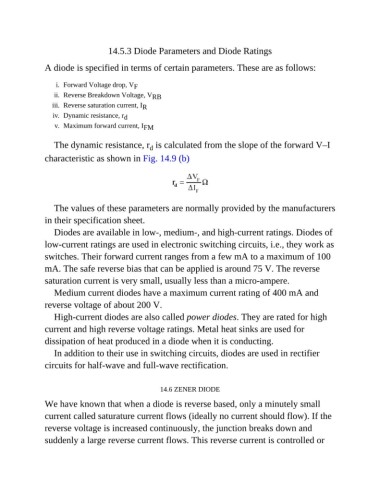
                  The dynamic resistance, r  is calculated from the slope of the forward V–I
                                                 d
               characteristic as shown in Fig. 14.9 (b)


                  The values of these parameters are normally provided by the manufacturers

               in their specification sheet.
                  Diodes are available in low-, medium-, and high-current ratings. Diodes of

               low-current ratings are used in electronic switching circuits, i.e., they work as
               switches. Their forward current ranges from a few mA to a maximum of 100

               mA. The safe reverse bias that can be applied is around 75 V. The reverse
               saturation current is very small, usually less than a micro-ampere.
                  Medium current diodes have a maximum current rating of 400 mA and

               reverse voltage of about 200 V.
                  High-current diodes are also called power diodes. They are rated for high

               current and high reverse voltage ratings. Metal heat sinks are used for
               dissipation of heat produced in a diode when it is conducting.
                  In addition to their use in switching circuits, diodes are used in rectifier

               circuits for half-wave and full-wave rectification.


                                                     14.6 ZENER DIODE

               We have known that when a diode is reverse based, only a minutely small
               current called saturature current flows (ideally no current should flow). If the

               reverse voltage is increased continuously, the junction breaks down and
               suddenly a large reverse current flows. This reverse current is controlled or

