


Page 10 - textbook5chapters
P. 10
SURGICAL ANATOMY IN PELVIC

 131GYNAECOLOGIC ONCOLOGY

                                                             Hugo Gaspar MD
                                     Octavio Arencibia Sanchez, MD PhD

                                                        Jordi Ponce, MD PhD

Introduction                                                  Transversalis

The objective of this chapter is the description of key               fascia      Medial     Medial umbilical
anatomical concepts needed to understand the surgical         Peritoneum         umbilical  ligament (uracaus)
procedures in this section.                                                      ligament
                                                                                                            Transversus
Anterior Abdominal Wall                                                                                 abdominis musIcnlteernal oblique
                                                                                 Rectus abdominis
Anatomic knowledge of anterior abdominal wall is crucial      Ventral layer of                     mucsle
to avoid neurovascular complications and hernias.
                                                              the rectus sheath                                           External
Muscles
                                                                                                                          oblique muscle
They can be divided into: the flank muscles (external
oblique, internal oblique and transversus abdominis           Transversalis
muscles) and the vertical muscles (rectus abdominis and
pyramidal muscles).                                           fascia             Linea alba         Apneurosis of the
                                                                                                 internal oblique muscle
    The external oblique muscle has its origin in the         Peritoneum Dorsal layer of
lower ribs, its fibers are oriented caudal and medially.
The internal oblique muscle arises from the iliac crest                       the rectus sheath
and outer third of the inguinal ligament but its fibers
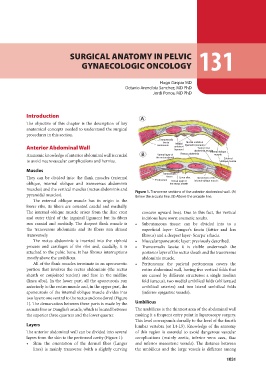
run cranial and medially. The deepest flank muscle is         Figure 1. Transverse sections of the anterior abdominal wall. (A)
the transversus abdominis and its fibers run almost           Below the arcuate line. (B) Above the arcuate line.
transversely.
                                                                  concave upward line). Due to this fact, the vertical
    The rectus abdominis is inserted into the xiphoid             incisions have worst cosmetic results.
process and cartilages of the ribs and, caudally, it is       • Subcutaneous tissue: can be divided into to a
attached to the pubic bone. It has fibrous interruptions          superficial layer- Camper’s fascia (fattier and less
mostly above the umbilicus.                                       fibrous) and a deepest layer- Scarpa´s fascia.
                                                              • Muscularaponeurotic layer: previously described.
    All of the flank muscles terminate in an aponeurotic      • Transversalis fascia: it is visible underneath the
portion that involves the rectus abdominis (the rectus            posterior layer of the rectus sheath and the transversus
sheath or conjoined tendon) and fuse in the midline               abdominis muscle.
(linea alba). In the lower part, all the aponeurosis run      • Peritoneum: the parietal peritoneum covers the
anteriorly to the rectus muscle and, in the upper part, the       entire abdominal wall, having five vertical folds that
aponeurosis of the internal oblique muscle divides into           are caused by different structures: a single median
two layers: one ventral to the rectus and one dorsal (Figure      fold (uracus), two medial umbilical folds (obliterated
1). The demarcation between these parts is made by the            umbilical arteries) and two lateral umbilical folds
arcuate line or Douglas’s arcade, which is located between        (inferior epigastric vessels).
the superior three quarters and the lower quarter.
                                                              Umbilicus
Layers
                                                              The umbilicus is the thinnest area of the abdominal wall
The anterior abdominal wall can be divided into several       making it a frequent entry point in laparoscopy surgery.
layers from the skin to the peritoneal cavity (Figure 1):     This level corresponds dorsally to the level of the fourth
• Skin: the orientation of the dermal fiber (Langer           lumbar vertebra (or L4-L5). Knowledge of the anatomy
                                                              of this region is essential to avoid dangerous vascular
    lines) is mainly transverse (with a slightly curving      complications (mainly aortic, inferior vena cava, iliac
                                                              and inferior mesenteric vessels). The distance between
                                                              the umbilicus and the large vessels is different among

                                                                                                                               1031

