


Page 87 - Computer Graphics Handout
P. 87
Physicists and mathematicians use the termvector  for any quantity with direction and magnitude. Physical quantities, such as
          velocity and force, are vectors. A vector does not, however, have a fixed location in space.
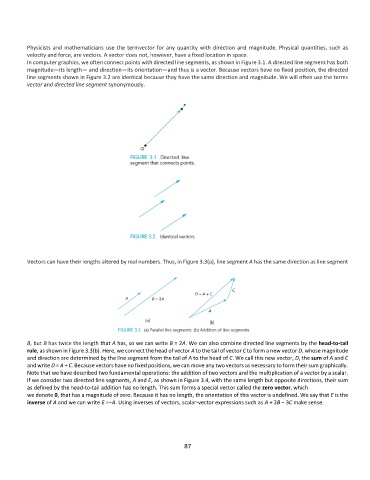
          In computer graphics, we often connect points with directed line segments, as shown in Figure 3.1. A directed line segment has both
          magnitude—its length— and direction—its orientation—and thus is a vector. Because vectors have no fixed position, the directed
          line segments shown in Figure 3.2 are identical because they have the same direction and magnitude. We will often use the terms
          vector and directed line segment synonymously.


          Vectors can have their lengths altered by real numbers. Thus, in Figure 3.3(a), line segment A has the same direction as line segment


          B, but B has twice the length that A has, so we can write B = 2A. We can also combine directed line segments by the head-to-tail
          rule, as shown in Figure 3.3(b). Here, we connect the head of vector A to the tail of vector C to form a new vector D, whose magnitude
          and direction are determined by the line segment from the tail of A to the head of C. We call this new vector, D, the sum of A and C
          and write D = A + C. Because vectors have no fixed positions, we can move any two vectors as necessary to form their sum graphically.
          Note that we have described two fundamental operations: the addition of two vectors and the multiplication of a vector by a scalar.
          If we consider two directed line segments, A and E, as shown in Figure 3.4, with the same length but opposite directions, their sum
          as defined by the head-to-tail addition has no length. This sum forms a special vector called the zero vector, which
          we denote 0, that has a magnitude of zero. Because it has no length, the orientation of this vector is undefined. We say that E is the
          inverse of A and we can write E =−A. Using inverses of vectors, scalar-vector expressions such as A + 2B − 3C make sense.


                                                              87

