


Page 92 - Computer Graphics Handout
P. 92
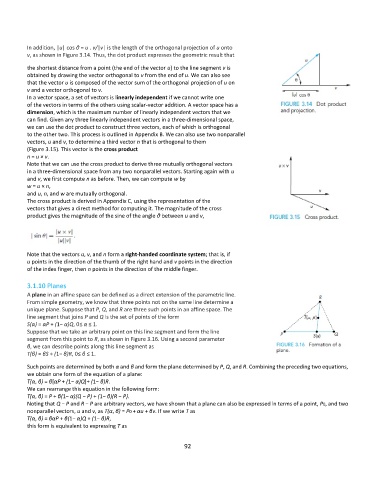
In addition, |u| cos θ = u . v/|v| is the length of the orthogonal projection of u onto
          v, as shown in Figure 3.14. Thus, the dot product expresses the geometric result that

          the shortest distance from a point (the end of the vector u) to the line segment v is
          obtained by drawing the vector orthogonal to v from the end of u. We can also see
          that the vector u is composed of the vector sum of the orthogonal projection of u on
          v and a vector orthogonal to v.
          In a vector space, a set of vectors is linearly independent if we cannot write one
          of the vectors in terms of the others using scalar-vector addition. A vector space has a
          dimension, which is the maximum number of linearly independent vectors that we
          can find. Given any three linearly independent vectors in a three-dimensional space,
          we can use the dot product to construct three vectors, each of which is orthogonal
          to the other two. This process is outlined in Appendix B. We can also use two nonparallel
          vectors, u and v, to determine a third vector n that is orthogonal to them
          (Figure 3.15). This vector is the cross product
          n = u × v.
          Note that we can use the cross product to derive three mutually orthogonal vectors
          in a three-dimensional space from any two nonparallel vectors. Starting again with u
          and v, we first compute n as before. Then, we can compute w by
          w = u × n,
          and u, n, and w are mutually orthogonal.
          The cross product is derived in Appendix C, using the representation of the
          vectors that gives a direct method for computing it. The magnitude of the cross
          product gives the magnitude of the sine of the angle θ between u and v,


          Note that the vectors u, v, and n form a right-handed coordinate system; that is, if
          u points in the direction of the thumb of the right hand and v points in the direction
          of the index finger, then n points in the direction of the middle finger.

          3.1.10 Planes
          A plane in an affine space can be defined as a direct extension of the parametric line.
          From simple geometry, we know that three points not on the same line determine a
          unique plane. Suppose that P, Q, and R are three such points in an affine space. The
          line segment that joins P and Q is the set of points of the form
          S(α) = αP + (1− α)Q, 0≤ α ≤ 1.
          Suppose that we take an arbitrary point on this line segment and form the line
          segment from this point to R, as shown in Figure 3.16. Using a second parameter
          β, we can describe points along this line segment as
          T(β) = βS + (1− β)R, 0≤ β ≤ 1.

          Such points are determined by both α and β and form the plane determined by P, Q, and R. Combining the preceding two equations,
          we obtain one form of the equation of a plane:
          T(α, β) = β[αP + (1− α)Q]+ (1− β)R.
          We can rearrange this equation in the following form:
          T(α, β) = P + β(1− α)(Q − P) + (1− β)(R − P).
          Noting that Q − P and R − P are arbitrary vectors, we have shown that a plane can also be expressed in terms of a point, P0, and two
          nonparallel vectors, u and v, as T(α, β) = P0 + αu + βv. If we write T as
          T(α, β) = βαP + β(1− α)Q + (1− β)R,
          this form is equivalent to expressing T as


                                                              92

