


Page 95 - Computer Graphics Handout
P. 95
All the primitives with which we work can be specified through a set of vertices. As we move away from abstract objects to real
          objects, we must consider how we represent points in space in a manner that can be used within our graphics systems.


          3.3 COORDINATE SYSTEMS AND FRAMES


          So far, we have considered vectors and points as abstract objects, without representing them in an underlying reference system. In
          a three-dimensional vector space, we can represent any vector w uniquely in terms of any three linearly independent vectors,
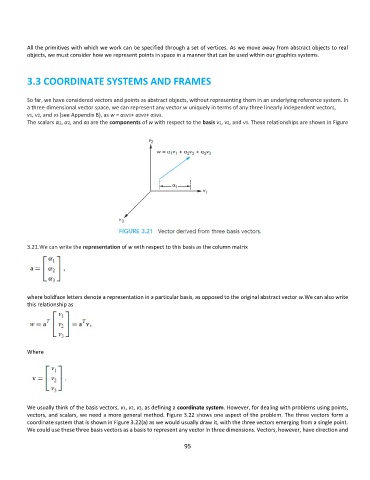
          v1, v2, and v3 (see Appendix B), as w = α1v1+ α2v2+ α3v3.
          The scalars α1, α2, and α3 are the components of w with respect to the basis v1, v2, and v3. These relationships are shown in Figure


          3.21.We can write the representation of w with respect to this basis as the column matrix


          where boldface letters denote a representation in a particular basis, as opposed to the original abstract vector w.We can also write
          this relationship as


          Where


          We usually think of the basis vectors, v1, v2, v3, as defining a coordinate system. However, for dealing with problems using points,
          vectors, and scalars, we need a more general method. Figure 3.22 shows one aspect of the problem. The three vectors form a
          coordinate system that is shown in Figure 3.22(a) as we would usually draw it, with the three vectors emerging from a single point.
          We could use these three basis vectors as a basis to represent any vector in three dimensions. Vectors, however, have direction and

                                                              95

