


Page 96 - Computer Graphics Handout
P. 96
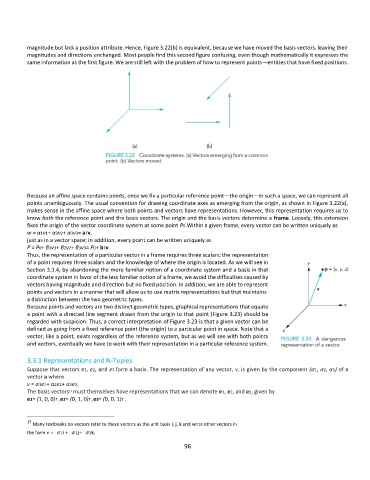
magnitude but lack a position attribute. Hence, Figure 3.22(b) is equivalent, because we have moved the basis vectors, leaving their
          magnitudes and directions unchanged. Most people find this second figure confusing, even though mathematically it expresses the
          same information as the first figure. We are still left with the problem of how to represent points—entities that have fixed positions.


          Because an affine space contains points, once we fix a particular reference point—the origin—in such a space, we can represent all
          points unambiguously. The usual convention for drawing coordinate axes as emerging from the origin, as shown in Figure 3.22(a),
          makes sense in the affine space where both points and vectors have representations. However, this representation requires us to
          know both the reference point and the basis vectors. The origin and the basis vectors determine a frame. Loosely, this extension
          fixes the origin of the vector coordinate system at some point P0.Within a given frame, every vector can be written uniquely as
          w = α1v1+ α2v2+ α3v3= aTv,
          just as in a vector space; in addition, every point can be written uniquely as
          P = P0+ β1v1+ β2v2+ β3v3= P0+ bTv.
          Thus, the representation of a particular vector in a frame requires three scalars; the representation
          of a point requires three scalars and the knowledge of where the origin is located. As we will see in
          Section 3.3.4, by abandoning the more familiar notion of a coordinate system and a basis in that
          coordinate system in favor of the less familiar notion of a frame, we avoid the difficulties caused by
          vectors having magnitude and direction but no fixed position. In addition, we are able to represent
          points and vectors in a manner that will allow us to use matrix representations but that maintains
          a distinction between the two geometric types.
          Because points and vectors are two distinct geometric types, graphical representations that equate
          a point with a directed line segment drawn from the origin to that point (Figure 3.23) should be
          regarded with suspicion. Thus, a correct interpretation of Figure 3.23 is that a given vector can be
          defined as going from a fixed reference point (the origin) to a particular point in space. Note that a
          vector, like a point, exists regardless of the reference system, but as we will see with both points
          and vectors, eventually we have to work with their representation in a particular reference system.

          3.3.1 Representations and N-Tuples
          Suppose that vectors e1, e2, and e3 form a basis. The representation of any vector, v, is given by the component (α1, α2, α3) of a
          vector a where
          v = α1e1+ α2e2+ α3e3.
          The basis vectors  must themselves have representations that we can denote e1, e2, and e3, given by
                        17
          e1= (1, 0, 0)T ,e2= (0, 1, 0)T ,e3= (0, 0, 1)T .


          17
            Many textbooks on vectors refer to these vectors as the unit basis i, j, k and write other vectors in
          the form v = α1i + α2j+ α3k.
                                                              96

