


Page 97 - Computer Graphics Handout
P. 97
In other words, the 3-tuple (1, 0, 0) is the representation of the first basis vector. Consequently, rather than thinking in terms of
          abstract vectors, we can work with 3-tuples and we can write the representation of any vector v as a column matrix a or
          the 3-tuple (α1, α2, α3), where
          a = α1e1+ α2e2+ α3e3.
          The basis 3-tuples e1, e2, and e3 are vectors in the familiar Euclidean space R3. The vector space R3 is equivalent (or homomorphic)
          to the vector space of our original geometric vectors. From a practical perspective, it is almost always easier to work with 3-tuples
          (or more generally n-tuples) than with other representations.

          3.3.2 Change of Coordinate Systems
          Frequently, we are required to find how the representation of a vector changes when we change the basis vectors. For example, in
          OpenGL, we specify our geometry using the coordinate system or frame that is natural for the model, which is known as the object
          or model frame. Models are then brought into the world frame. At some point, we want to know how these objects appear to the
          camera. It is natural at that point to convert from the world frame to the camera or eye frame. The conversion from the object
          frame to the eye frame is done by the model-view matrix. Let’s consider changing representations for vectors first. Suppose that
          {v1, v2, v3} and {u1, u2, u3} are two bases. Each basis vector in the second set can be represented in terms of the first basis (and vice
          versa). Hence, there exist nine scalar components, {γij}, such that
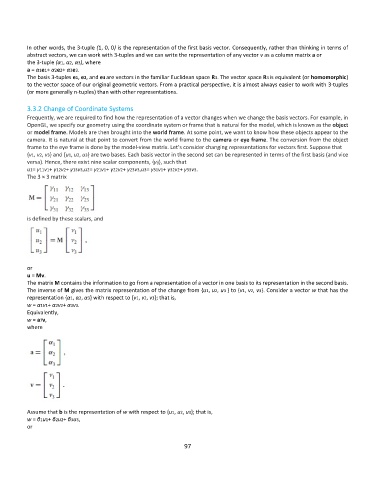
          u1= γ11v1+ γ12v2+ γ13v3,u2= γ21v1+ γ22v2+ γ23v3,u3= γ31v1+ γ32v2+ γ33v3.
          The 3 × 3 matrix


          is defined by these scalars, and


          or
          u = Mv.
          The matrix M contains the information to go from a representation of a vector in one basis to its representation in the second basis.
          The inverse of M gives the matrix representation of the change from {u1, u2, u3 } to {v1, v2, v3}. Consider a vector w that has the
          representation {α1, α2, α3} with respect to {v1, v2, v3}; that is,
          w = α1v1+ α2v2+ α3v3.
          Equivalently,
          w = aTv,
          where


          Assume that b is the representation of w with respect to {u1, u2, u3}; that is,
          w = β1u1+ β2u2+ β3u3,
          or

                                                              97

