


Page 102 - Computer Graphics Handout
P. 102
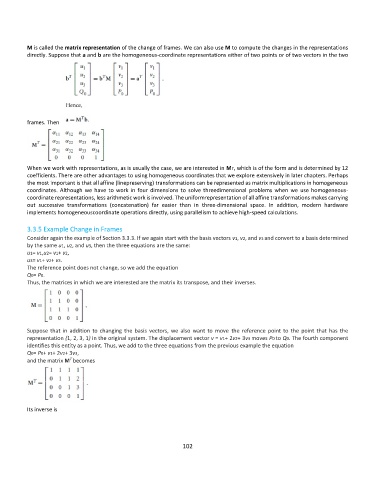
M is called the matrix representation of the change of frames. We can also use M to compute the changes in the representations
          directly. Suppose that a and b are the homogeneous-coordinate representations either of two points or of two vectors in the two


          frames. Then


          When we work with representations, as is usually the case, we are interested in MT, which is of the form and is determined by 12
          coefficients. There are other advantages to using homogeneous coordinates that we explore extensively in later chapters. Perhaps
          the most important is that all affine (linepreserving) transformations can be represented as matrix multiplications in homogeneous
          coordinates.  Although  we  have  to  work  in  four  dimensions  to  solve  threedimensional  problems  when  we  use  homogeneous-
          coordinate representations, less arithmetic work is involved. The uniformrepresentation of all affine transformations makes carrying
          out  successive  transformations  (concatenation)  far  easier  than  in  three-dimensional  space.  In  addition,  modern  hardware
          implements homogeneouscoordinate operations directly, using parallelism to achieve high-speed calculations.

          3.3.5 Example Change in Frames
          Consider again the example of Section 3.3.3. If we again start with the basis vectors v1, v2, and v3 and convert to a basis determined
          by the same u1, u2, and u3, then the three equations are the same:
          u1= v1,u2= v1+ v2,
          u3= v1+ v2+ v3.
          The reference point does not change, so we add the equation
          Q0= P0.
          Thus, the matrices in which we are interested are the matrix its transpose, and their inverses.


          Suppose  that  in  addition  to changing  the  basis  vectors, we  also  want  to  move  the  reference  point  to  the  point  that  has  the
          representation (1, 2, 3, 1) in the original system. The displacement vector v = v1+ 2v2+ 3v3 moves P0 to Q0. The fourth component
          identifies this entity as a point. Thus, we add to the three equations from the previous example the equation
          Q0= P0+ v1+ 2v2+ 3v3,
                        T
          and the matrix M  becomes


          Its inverse is


                                                             102

