


Page 100 - Computer Graphics Handout
P. 100
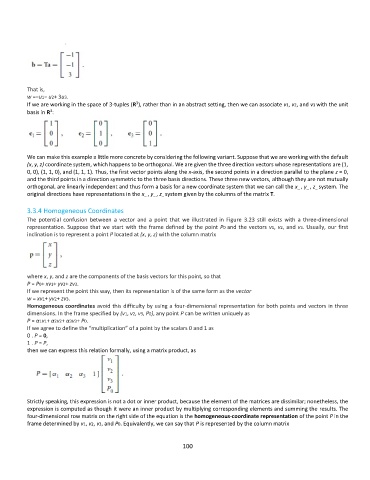
That is,
          w =−u1− u2+ 3u3.
                                              3
          If we are working in the space of 3-tuples (R ), rather than in an abstract setting, then we can associate v1, v2, and v3 with the unit
                  3
          basis in R :


          We can make this example a little more concrete by considering the following variant. Suppose that we are working with the default
          (x, y, z) coordinate system, which happens to be orthogonal. We are given the three direction vectors whose representations are (1,
          0, 0), (1, 1, 0), and (1, 1, 1). Thus, the first vector points along the x-axis, the second points in a direction parallel to the plane z = 0,
          and the third points in a direction symmetric to the three basis directions. These three new vectors, although they are not mutually
          orthogonal, are linearly independent and thus form a basis for a new coordinate system that we can call the x_ , y_ , z_ system. The
          original directions have representations in the x_ , y_ , z_ system given by the columns of the matrix T.

          3.3.4 Homogeneous Coordinates
          The  potential  confusion  between  a  vector  and  a  point  that  we  illustrated  in  Figure  3.23  still  exists  with  a  three-dimensional
          representation. Suppose that we start with the frame defined by the point  P0 and the vectors v1, v2, and v3. Usually, our first
          inclination is to represent a point P located at (x, y, z) with the column matrix


          where x, y, and z are the components of the basis vectors for this point, so that
          P = P0+ xv1+ yv2+ zv3.
          If we represent the point this way, then its representation is of the same form as the vector
          w = xv1+ yv2+ zv3.
          Homogeneous coordinates avoid this difficulty by using a four-dimensional representation for both points and vectors in three
          dimensions. In the frame specified by (v1, v2, v3, P0), any point P can be written uniquely as
          P = α1v1+ α2v2+ α3v3+ P0.
          If we agree to define the “multiplication” of a point by the scalars 0 and 1 as
          0 . P = 0,
          1 . P = P,
          then we can express this relation formally, using a matrix product, as


          Strictly speaking, this expression is not a dot or inner product, because the element of the matrices are dissimilar; nonetheless, the
          expression is computed as though it were an inner product by multiplying corresponding elements and summing the results. The
          four-dimensional row matrix on the right side of the equation is the homogeneous-coordinate representation of the point P in the
          frame determined by v1, v2, v3, and P0. Equivalently, we can say that P is represented by the column matrix


                                                             100

