


Page 98 - Computer Graphics Handout
P. 98
Where


          Then, using our representation of the second basis in terms of the first, we find that


          Thus,
          a = MTb.
          The matrix
          T = (MT)−1
          takes us from a to b, through the simple matrix equation
          b = Ta.
          Thus, rather than working with our original vectors, typically directed line segments, we can work
          instead with their representations, which are 3-tuples or elements of R3. This result is important
          because  it  moves  us  from  considering  abstract  vectors  to  working  with  column  matrices  of
          scalars—the vectors’ representations. The important point to remember is that whenever we
          work with columns of real numbers as “vectors,” there is an underlying basis of which we must
          not lose track, lest we end up working in the wrong coordinate system.
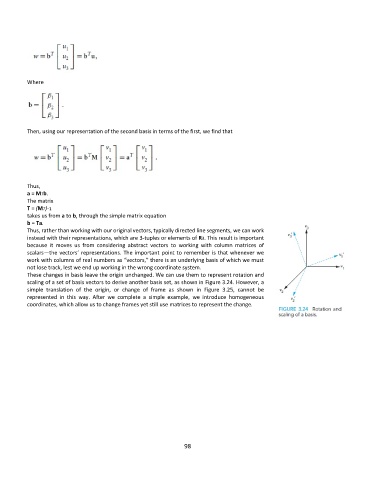
          These changes in basis leave the origin unchanged. We can use them to represent rotation and
          scaling of a set of basis vectors to derive another basis set, as shown in Figure 3.24. However, a
          simple  translation  of  the  origin,  or  change  of  frame  as  shown  in  Figure  3.25,  cannot  be
          represented  in  this  way.  After  we  complete  a  simple  example,  we  introduce  homogeneous
          coordinates, which allow us to change frames yet still use matrices to represent the change.


                                                              98

