


Page 93 - Computer Graphics Handout
P. 93
T(α, β_ , γ ) = α_P + β_Q + γ_R,
          as long as
          α_ + β_ + γ_ = 1.
          The representation of a point by (α_ , β_ , γ_) is called its barycentric coordinate representation. We can also observe that for 0≤ α,
          β ≤ 1, all the points T(α, β) lie in the triangle formed by P, Q, and R. If a point P lies in the plane, then
          P − P0= αu + βv.
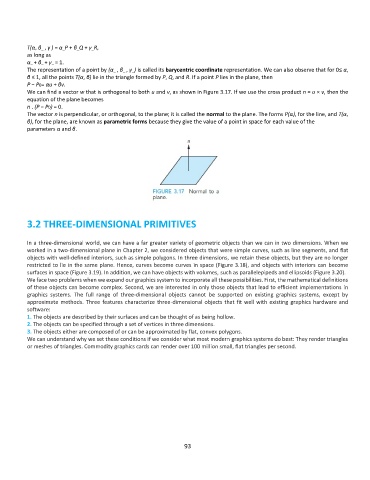
          We can find a vector w that is orthogonal to both u and v, as shown in Figure 3.17. If we use the cross product n = u × v, then the
          equation of the plane becomes
          n . (P − P0) = 0.
          The vector n is perpendicular, or orthogonal, to the plane; it is called the normal to the plane. The forms P(α), for the line, and T(α,
          β), for the plane, are known as parametric forms because they give the value of a point in space for each value of the
          parameters α and β.


          3.2 THREE-DIMENSIONAL PRIMITIVES


          In a three-dimensional world, we can have a far greater variety of geometric objects than we can in two dimensions. When we
          worked in a two-dimensional plane in Chapter 2, we considered objects that were simple curves, such as line segments, and flat
          objects with well-defined interiors, such as simple polygons. In three dimensions, we retain these objects, but they are no longer
          restricted to lie in the same plane. Hence, curves become curves in space (Figure 3.18), and objects with interiors can become
          surfaces in space (Figure 3.19). In addition, we can have objects with volumes, such as parallelepipeds and ellipsoids (Figure 3.20).
          We face two problems when we expand our graphics system to incorporate all these possibilities. First, the mathematical definitions
          of these objects can become complex. Second, we are interested in only those objects that lead to efficient implementations in
          graphics  systems.  The  full  range  of  three-dimensional  objects  cannot  be  supported  on  existing  graphics  systems,  except  by
          approximate methods. Three features characterize three-dimensional objects that fit well with existing graphics hardware and
          software:
          1. The objects are described by their surfaces and can be thought of as being hollow.
          2. The objects can be specified through a set of vertices in three dimensions.
          3. The objects either are composed of or can be approximated by flat, convex polygons.
          We can understand why we set these conditions if we consider what most modern graphics systems do best: They render triangles
          or meshes of triangles. Commodity graphics cards can render over 100 million small, flat triangles per second.


                                                              93

