


Page 88 - Computer Graphics Handout
P. 88
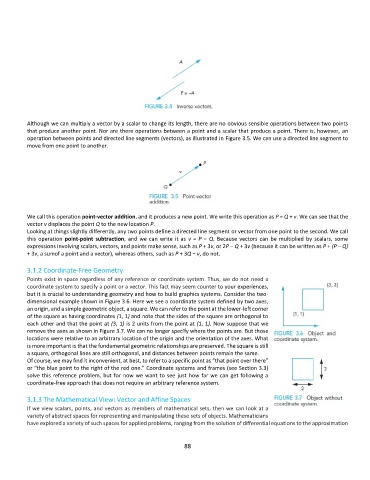
Although we can multiply a vector by a scalar to change its length, there are no obvious sensible operations between two points
          that produce another point. Nor are there operations between a point and a scalar that produce a point. There is, however, an
          operation between points and directed line segments (vectors), as illustrated in Figure 3.5. We can use a directed line segment to
          move from one point to another.


          We call this operation point-vector addition, and it produces a new point. We write this operation as P = Q + v. We can see that the
          vector v displaces the point Q to the new location P.
          Looking at things slightly differently, any two points define a directed line segment or vector from one point to the second. We call
          this operation  point-point subtraction, and we can write  it as  v = P −  Q. Because vectors can be multiplied by scalars, some
          expressions involving scalars, vectors, and points make sense, such as P + 3v, or 2P − Q + 3v (because it can be written as P + (P − Q)
          + 3v, a sumof a point and a vector), whereas others, such as P + 3Q − v, do not.

          3.1.2 Coordinate-Free Geometry
          Points exist in space regardless of any reference or coordinate system. Thus, we do not need a
          coordinate system to specify a point or a vector. This fact may seem counter to your experiences,
          but it is crucial to understanding geometry and how to build graphics systems. Consider the two-
          dimensional example shown in Figure 3.6. Here we see a coordinate system defined by two axes,
          an origin, and a simple geometric object, a square. We can refer to the point at the lower-left corner
          of the square as having coordinates (1, 1) and note that the sides of the square are orthogonal to
          each other and that the point at (3, 1) is 2 units from the point at (1, 1). Now suppose that we
          remove the axes as shown in Figure 3.7. We can no longer specify where the points are. But those
          locations were relative to an arbitrary location of the origin and the orientation of the axes. What
          is more important is that the fundamental geometric relationships are preserved. The square is still
          a square, orthogonal lines are still orthogonal, and distances between points remain the same.
          Of course, we may find it inconvenient, at best, to refer to a specific point as “that point over there”
          or “the blue point to the right of the red one.” Coordinate systems and frames (see Section 3.3)
          solve this reference problem, but for now we want to see just how far we can get following a
          coordinate-free approach that does not require an arbitrary reference system.

          3.1.3 The Mathematical View: Vector and Affine Spaces
          If we view scalars, points, and vectors as members of mathematical sets, then we can look at a
          variety of abstract spaces for representing and manipulating these sets of objects. Mathematicians
          have explored a variety of such spaces for applied problems, ranging from the solution of differential equations to the approximation


                                                              88

