


Page 91 - Computer Graphics Handout
P. 91
by a scalar, and the addition of a vector and a point are defined, the addition of two
          arbitrary points and the multiplication of a point by a scalar are not. However, there
          is an operation called affine addition that has certain elements of these latter two
          operations. For any point Q, vector v, and positive scalar α,
          P = Q + αv
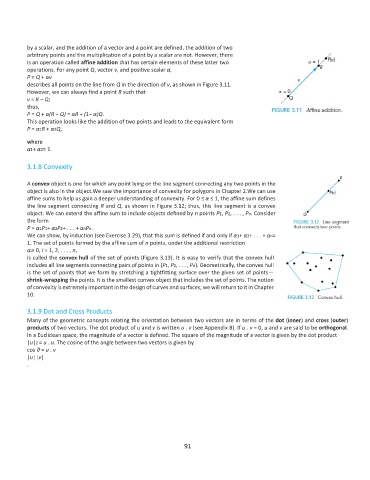
          describes all points on the line from Q in the direction of v, as shown in Figure 3.11.
          However, we can always find a point R such that
          v = R − Q;
          thus,
          P = Q + α(R − Q) = αR + (1− α)Q.
          This operation looks like the addition of two points and leads to the equivalent form
          P = α1R + α2Q,

          where
          α1+ α2= 1.

          3.1.8 Convexity

          A convex object is one for which any point lying on the line segment connecting any two points in the
          object is also in the object.We saw the importance of convexity for polygons in Chapter 2.We can use
          affine sums to help us gain a deeper understanding of convexity. For 0 ≤ α ≤ 1, the affine sum defines
          the line segment connecting R and Q, as shown in Figure 3.12; thus, this line segment is a convex
          object. We can extend the affine sum to include objects defined by n points P1, P2, . . . , Pn. Consider
          the form
          P = α1P1+ α2P2+ . . . + αnPn.
          We can show, by induction (see Exercise 3.29), that this sum is defined if and only if α1+ α2+ . . . + αn=
          1. The set of points formed by the affine sum of n points, under the additional restriction
          αi≥ 0, i = 1, 2, . . . , n,
          is called the convex hull of the set of points (Figure 3.13). It is easy to verify that the convex hull
          includes all line segments connecting pairs of points in {P1, P2, . . . , Pn}. Geometrically, the convex hull
          is the set of points that we form by stretching a tightfitting surface over the given set of points—
          shrink-wrapping the points. It is the smallest convex object that includes the set of points. The notion
          of convexity is extremely important in the design of curves and surfaces; we will return to it in Chapter
          10.

          3.1.9 Dot and Cross Products
          Many of the geometric concepts relating the orientation between two vectors are in terms of the dot (inner) and cross (outer)
          products of two vectors. The dot product of u and v is written u . v (see Appendix B). If u . v = 0, u and v are said to be orthogonal.
          In a Euclidean space, the magnitude of a vector is defined. The square of the magnitude of a vector is given by the dot product
          |u|2 = u . u. The cosine of the angle between two vectors is given by
          cos θ = u . v
          |u||v|
          .


                                                              91

