


Page 90 - Computer Graphics Handout
P. 90
We have not as yet introduced any reference system, such as a coordinate system; thus, for vectors and points, this notation refers
          to the abstract objects, rather than to these objects’ representations in a particular reference system. We use boldface letters for
          the latter in Section 3.3. The magnitude of a vector v is a real number denoted by |v|. The operation of vector–scalar multiplication
          (see Appendix B) has the property that |αv| = |α||v|,
          and the direction of αv is the same as the direction of v if α is positive and the opposite direction if α is negative. We have two
          equivalent operations that relate points and vectors. First, there is the subtraction of two points, P and Q—an operation that yields
          a vector v denoted by
          v = P − Q.
          As a consequence of this operation, given any point Q and vector v, there is a unique point, P, that
          satisfies the preceding relationship. We can express this statement as follows: Given a point Q and
          a vector v, there is a point P such that
          P = Q + v.
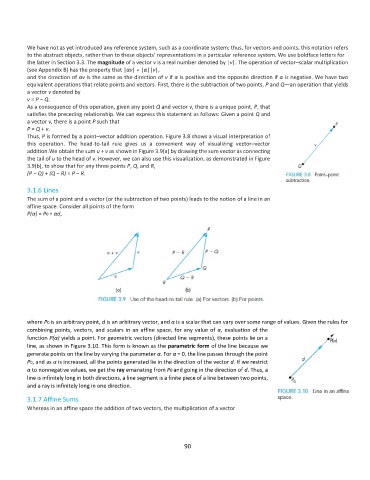
          Thus, P is formed by a point–vector addition operation. Figure 3.8 shows a visual interpretation of
          this  operation.  The  head-to-tail  rule  gives  us  a  convenient  way  of  visualizing  vector–vector
          addition.We obtain the sum u + v as shown in Figure 3.9(a) by drawing the sum vector as connecting
          the tail of u to the head of v. However, we can also use this visualization, as demonstrated in Figure
          3.9(b), to show that for any three points P, Q, and R,
          (P − Q) + (Q − R) = P − R.

          3.1.6 Lines
          The sum of a point and a vector (or the subtraction of two points) leads to the notion of a line in an
          affine space. Consider all points of the form
          P(α) = P0 + αd,


          where P0 is an arbitrary point, d is an arbitrary vector, and α is a scalar that can vary over some range of values. Given the rules for
          combining points, vectors, and scalars in an affine space, for any value of  α, evaluation of the
          function P(α) yields a point. For geometric vectors (directed line segments), these points lie on a
          line, as shown in Figure 3.10. This form is known as the parametric form of the line because we
          generate points on the line by varying the parameter α. For α = 0, the line passes through the point
          P0, and as α is increased, all the points generated lie in the direction of the vector d. If we restrict
          α to nonnegative values, we get the ray emanating from P0 and going in the direction of d. Thus, a
          line is infinitely long in both directions, a line segment is a finite piece of a line between two points,
          and a ray is infinitely long in one direction.

          3.1.7 Affine Sums
          Whereas in an affine space the addition of two vectors, the multiplication of a vector


                                                              90

