


Page 94 - Computer Graphics Handout
P. 94
Performance measurements for graphics systems usually are quoted for small threedimensional triangles that can be generated by
          triangle strips. In addition, these triangles are shaded, lit, and texture mapped, features that are implemented in the hardware of
          modern graphics cards.


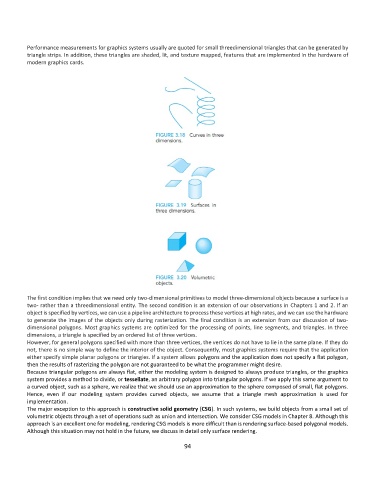
          The first condition implies that we need only two-dimensional primitives to model three-dimensional objects because a surface is a
          two- rather than a threedimensional entity. The second condition is an extension of our observations in Chapters 1 and 2. If an
          object is specified by vertices, we can use a pipeline architecture to process these vertices at high rates, and we can use the hardware
          to generate the images of the objects only during rasterization. The final condition is an extension from our discussion of two-
          dimensional polygons. Most graphics systems are optimized for the processing of points, line segments, and triangles. In three
          dimensions, a triangle is specified by an ordered list of three vertices.
          However, for general polygons specified with more than three vertices, the vertices do not have to lie in the same plane. If they do
          not, there is no simple way to define the interior of the object. Consequently, most graphics systems require that the application
          either specify simple planar polygons or triangles. If a system allows polygons and the application does not specify a flat polygon,
          then the results of rasterizing the polygon are not guaranteed to be what the programmer might desire.
          Because triangular polygons are always flat, either the modeling system is designed to always produce triangles, or the graphics
          system provides a method to divide, or tessellate, an arbitrary polygon into triangular polygons. If we apply this same argument to
          a curved object, such as a sphere, we realize that we should use an approximation to the sphere composed of small, flat polygons.
          Hence,  even  if  our  modeling  system  provides  curved  objects,  we  assume  that  a  triangle  mesh  approximation  is  used  for
          implementation.
          The major exception to this approach is constructive solid geometry (CSG). In such systems, we build objects from a small set of
          volumetric objects through a set of operations such as union and intersection. We consider CSG models in Chapter 8. Although this
          approach is an excellent one for modeling, rendering CSG models is more difficult than is rendering surface-based polygonal models.
          Although this situation may not hold in the future, we discuss in detail only surface rendering.

                                                              94

