


Page 203 - Candi Indonesia (Jawa)
P. 203
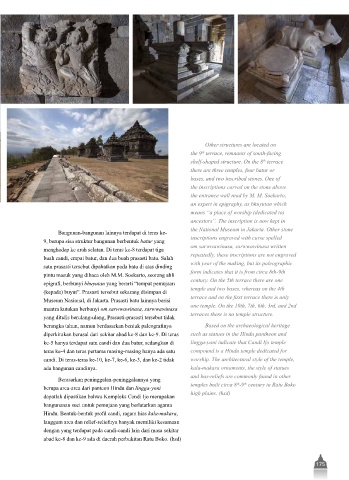
Other structures are located on
                                                                           the 9  terrace, remnants of south-facing
                                                                                th
                                                                                                        th
                                                                           shelf-shaped structure. On the 8  terrace
                                                                           there are three temples, four batur or
                                                                           bases, and two inscribed stones. One of
                                                                           the inscriptions carved on the stone above
                                                                           the entrance wall read by M. M. Soekarto,
                                                                           an expert in epigraphy, as bhuyutan which
                                                                           means “a place of worship (dedicated to)
                                                                           ancestors”. The inscription is now kept in
                                                                           the National Museum in Jakarta. Other stone
                        Bangunan-bangunan lainnya terdapat di teras ke-
                                                                           inscriptions engraved with curse spelled
                  9, berupa sisa struktur bangunan berbentuk EDWXU yang
                                                                           om sarwwawinasa, sarwwawinasa written
                  menghadap ke arah selatan. Di teras ke-8 terdapat tiga
                                                                           repeatedly, these inscriptions are not engraved
                  buah candi, empat batur, dan dua buah prasasti batu. Salah
                                                                           with year of the making, but its paleographic
                  satu prasasti tersebut dipahatkan pada batu di atas dinding
                                                                           form indicates that it is from circa 8th-9th
                  pintu masuk yang dibaca oleh M.M. Soekarto, seorang ahli
                                                                           century. On the 5th terrace there are one
                  HSLJUD¿  EHUEXQ\L EKX\XWDQ yang berarti “tempat pemujaan
                                                                           temple and two bases, whereas on the 4th
                  (kepada) buyut”. Prasasti tersebut sekarang disimpan di
                                                                           WHUUDFH DQG RQ WKH ¿UVW WHUUDFH WKHUH LV RQO\
                  Museum Nasional, di Jakarta. Prasasti batu lainnya berisi
                                                                           one temple. On the 10th, 7th, 6th, 3rd, and 2nd
                  mantra kutukan berbunyi RP VDUZZDZLQDVD  VDUZZDZLQDVD
                                                                           terraces there is no temple structure.
                  yang ditulis berulang-ulang, Prasasti-prasasti tersebut tidak
                  EHUDQJND WDKXQ  QDPXQ EHUGDVDUNDQ EHQWXN SDOHRJUD¿Q\D          Based on the archaeological heritage
                  diperkirakan berasal dari sekitar abad ke-8 dan ke-9. Di teras   such as statues in the Hindu pantheon and
                  ke-5 hanya terdapat satu candi dan dua batur, sedangkan di   lingga-yoni indicate that Candi Ijo temple
                  teras ke-4 dan teras pertama masing-masing hanya ada satu   compound is a Hindu temple dedicated for
                  candi. Di teras-teras ke-10, ke-7, ke-6, ke-3, dan ke-2 tidak   worship. The architectural style of the temple,
                  ada bangunan candinya.                                   kala-makara ornaments, the style of statues
                                                                           and bas-reliefs are commonly found in other
                        Berasarkan peninggalan-peninggalannya yang
                                                                           temples built circa 8 -9  century in Ratu Boko
                                                                                                th
                                                                                             th
                  berupa arca-arca dari panteon Hindu dan OLQJJD \RQL
                  dapatlah dipastikan bahwa Kompleks Candi Ijo merupakan   high plains. (hsd)
                  bangunanan suci untuk pemujaan yang berlatarkan agama
                  +LQGX  %HQWXN EHQWXN SUR¿O FDQGL  UDJDP KLDV NDOD PDNDUD,
                  langgam arca dan relief-reliefnya banyak memiliki kesamaan
                  dengan yang terdapat pada candi-candi lain dari masa sekitar
                  abad ke-8 dan ke-9 ada di daerah perbukitan Ratu Boko. (hsd)


                                                                                                                            175

