


Page 1520 - Foton Workshop Manual - Auman EST-M
P. 1520
EL - 96                         Electrical system – electrical components

    IN        Change

              1. Recovering the refrigerant
    DI        a. Switch on the A/C switch.
              b. Run the engine at the speed of 1000r/min for 5~6min to make the refrigerant throughout the system. And
    EG        try to collect refrigeration oil from each component into the compressor as far as possible.

              c. Stop the engine.
    TR                                                     Caution

              Notice that refrigerant may pollute the environment. Do not release the refrigerant into the atmosphere.
    AX
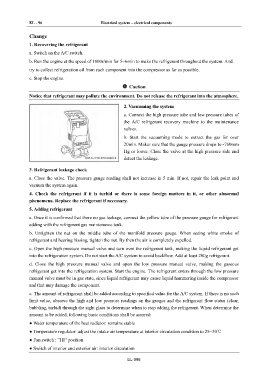
                                                        2. Vacuuming the system

                                                        a. Connect the high pressure tube and low pressure tubes of
    FR
                                                        the  A/C  refrigerant  recovery  machine  to  the  maintenance

                                                        valves.
    ST
                                                        b.  Start  the  vacuuming  mode  to  extract  the  gas  for  over
                                                        20min. Maker sure that the gauge pressure drops to -760mm

    BR                                                  Hg or lower. Close the valve at the high pressure side and
                                                        detect the leakage.

    BW        3. Refrigerant leakage check
              a. Close the valve. The pressure gauge reading shall not increase in 5 min. If not, repair the leak point and

    EL        vacuum the system again.
              4.  Check  the  refrigerant  if  it  is  turbid  or  there  is  some  foreign  matters  in  it,  or  other  abnormal
              phenomena. Replace the refrigerant if necessary.

              5. Adding refrigerant
              a. Once it is confirmed that there no gas leakage, connect the yellow tube of the pressure gauge for refrigerant
              adding with the refrigerant gas maintenance tank.

              b.  Untighten  the  nut  on  the  middle  tube  of  the  manifold  pressure  gauge.  When  seeing  white  smoke  of

              refrigerant and hearing hissing, tighten the nut. By then the air is completely expelled.

              c. Open the high pressure manual valve and turn over the refrigerant tank, making the liquid refrigerant get

              into the refrigeration system. Do not start the A/C system to avoid backflow. Add at least 200g refrigerant.

              d.  Close  the  high  pressure  manual  valve  and  open  the  low  pressure  manual  valve,  making  the  gaseous

              refrigerant get into the refrigeration system. Start the engine. The refrigerant enters through the low pressure
              manual valve must be in gas state, since liquid refrigerant may cause liquid hammering inside the compressor
              and that may damage the component.

              e. The amount of refrigerant shall be added according to specified value for the A/C system. If there is no such
              limit value, observe the high and low pressure readings on the gauges and the refrigerant flow status (clear,
              bubbling, turbid) through the sight glass to determine when to stop adding the refrigerant. When determine the

              amount to be added, following basic conditions shall be assured:

              ● Water temperature of the heat radiator: remains stable

              ● Temperature regulator: adjust the intake air temperature at interior circulation condition to 25~30℃

              ● Fan switch : ”HI“ position
              ● Switch of interior and exterior air: interior circulation

                                                          EL-096

