


Page 58 - Pharmd general phytochemistry I-Final2024_LEUCTERS
P. 58
Detection of cyanogenetic glycosides
Guignard,s test

 1- The plant material is reduced into small fragments & then moistened
     with water in a flask.

 2- A strip of filter paper moistened with sodium picrate is suspended in
     the neck of the flask.

 3- The flask is stoppered, and incubated in a warm place for about 30 min.
      to allow the enzymatic action with the liberation of HCN which turns
     the sodium picrate paper into Brick-red in color (sod. Isopurpurate).

    Uses:
 In small quantities these glycosides do exhibit expectorant, sedative and
  Digestive properties.
 Prunasin, the main antitussive principle ofWild cherry bark is an
  excellent cough remedy as well as a flavouring agent used
  in cough syrups. It is of benefit as a tea for bronchitis.

            IV- Sulphur Containing Glycosides

               (Thioglycosides) (Glucosinolates)

A number of plants of the family Cruciferae yield glycosides
containing sulphur. Hydrolysis of these glycosides yields genins
of thiocyanate structure (mustard oils).
The best known representatives of this class are sinigrin in black mustard
and sinalbin, in white mustard seeds and Glucoraphenin.

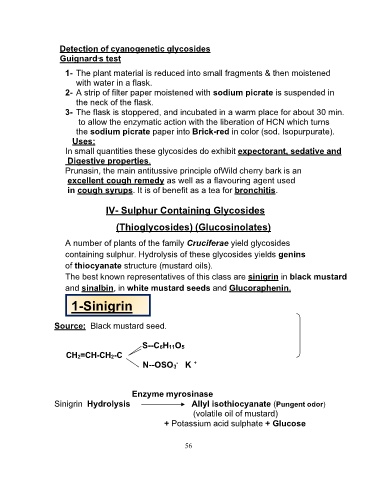
 1-Sinigrin

Source: Black mustard seed.

CH2=CH-CH2-C         S--C6H11O5
                     N--OSO3- K +

                     Enzyme myrosinase

Sinigrin Hydrolysis          Allyl isothiocyanate (Pungent odor)

                                 (volatile oil of mustard)

                     + Potassium acid sulphate + Glucose

                             56

