


Page 210 - Sanidhya 2025
P. 210
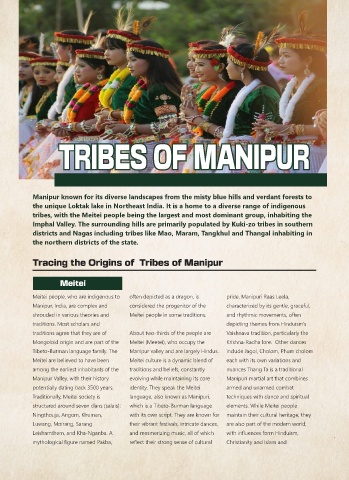
TRIBES OF MANIPUR
                     TRIBE
                                                                               NIPUR
                                            S OF MA


            Manipur known for its diverse landscapes from the misty blue hills and verdant forests to
            the unique Loktak lake in Northeast India. It is a home to a diverse range of indigenous
            tribes, with the Meitei people being the largest and most dominant group, inhabiting the
            Imphal Valley. The surrounding hills are primarily populated by Kuki-zo tribes in southern
            districts and Nagas including tribes like Mao, Maram, Tangkhul and Thangal inhabiting in
            the northern districts of the state.


            Tracing the Origins of  Tribes of Manipur


                     Meitei
            Meitei people, who are indigenous to   often depicted as a dragon, is   pride. Manipuri Raas Leela,
            Manipur, India, are complex and   considered the progenitor of the   characterized by its gentle, graceful,
            shrouded in various theories and   Meitei people in some traditions.   and rhythmic movements, often
            traditions. Most scholars and                                   depicting themes from Hinduism’s
            traditions agree that they are of   About two-thirds of the people are   Vaishnava tradition, particularly the
            Mongoloid origin and are part of the   Meitei (Meetei), who occupy the   Krishna-Radha lore.  Other dances
            Tibeto-Burman language family. The   Manipur valley and are largely Hindus.   include Jagoi, Cholom, Phum cholom
            Meitei are believed to have been   Meitei culture is a dynamic blend of   each with its own variations and
            among the earliest inhabitants of the   traditions and beliefs, constantly   nuances Thang Ta is a traditional
            Manipur Valley, with their history   evolving while maintaining its core   Manipuri martial art that combines
            potentially dating back 3500 years.   identity. They speak the Meitei   armed and unarmed combat
            Traditionally, Meitei society is   language, also known as Manipuri,   techniques with dance and spiritual
            structured around seven clans (salais):   which is a Tibeto-Burman language   elements. While Meitei people
            Ningthouja, Angom, Khuman,      with its own script. They are known for   maintain their cultural heritage, they
            Luwang, Moirang, Sarang         their vibrant festivals, intricate dances,   are also part of the modern world,
            Leishamthem, and Kha-Nganba. A   and mesmerizing music, all of which   with influences form Hinduism,
            mythological figure named Pakba,   reflect their strong sense of cultural   Christianity and Islam and

