


Page 212 - Sanidhya 2025
P. 212
Nagas

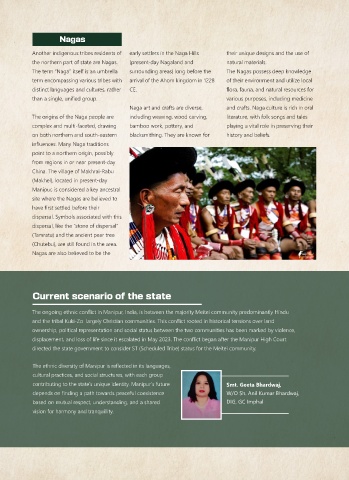
            Another indigenous tribes residents of   early settlers in the Naga Hills   their unique designs and the use of
            the northern part of state are Nagas.   (present-day Nagaland and   natural materials.
            The term “Naga” itself is an umbrella   surrounding areas) long before the   The Nagas possess deep knowledge
            term encompassing various tribes with   arrival of the Ahom kingdom in 1228   of their environment and utilize local
            distinct languages and cultures, rather   CE.                   flora, fauna, and natural resources for
            than a single, unified group.                                   various purposes, including medicine
                                            Naga art and crafts are diverse,   and crafts. Naga culture is rich in oral
            The origins of the Naga people are   including weaving, wood carving,   literature, with folk songs and tales
            complex and multi-faceted, drawing   bamboo work, pottery, and   playing a vital role in preserving their
            on both northern and south-eastern   blacksmithing. They are known for   history and beliefs.
            influences. Many Naga traditions
            point to a northern origin, possibly
            from regions in or near present-day
            China. The village of Makhrai-Rabu
            (Makhel), located in present-day
            Manipur, is considered a key ancestral
            site where the Nagas are believed to
            have first settled before their
            dispersal. Symbols associated with this
            dispersal, like the “stone of dispersal”
            (Tamratu) and the ancient pear tree
            (Chutebu), are still found in the area.
            Nagas are also believed to be the


            Current scenario of the state


            The ongoing ethnic conflict in Manipur, India, is between the majority Meitei community predominantly Hindu
            and the tribal Kuki-Zo  largely Christian communities. This conflict rooted in historical tensions over land
            ownership, political representation and social status between the two communities has been marked by violence,
            displacement, and loss of life since it escalated in May 2023. The conflict began after the Manipur High Court
            directed the state government to consider ST (Scheduled Tribe) status for the Meitei community.

            The ethnic diversity of Manipur is reflected in its languages,
            cultural practices, and social structures, with each group
            contributing to the state’s unique identity. Manipur’s future   Smt. Geeta Bhardwaj,
            depends on finding a path towards peaceful coexistence          W/O Sh. Anil Kumar Bhardwaj,
            based on mutual respect, understanding, and a shared            DIG, GC Imphal
            vision for harmony and tranquillity.

