


Page 211 - Sanidhya 2025
P. 211
engagement with education,
            employment and other opportunities.

            Meitei women conduct most of the
            trade in the valley and enjoy high
            social status. Meitei food habits
            revolve around rice, fish, and
            vegetables, often incorporating
            fermented items and local herbs. They
            have a strong preference for fresh,
            locally sourced ingredients and a
            unique culinary style characterized by
            both simplicity and complexity.


                      Kuki


            The Kuki people are believed to be of   further divided by the British into ‘old   The Kukis  speak  languages related to
            Tibeto-Burman origin, with migrations   Kukis’ and ‘new Kukis’.  kuki-chin linguistic family within the
            from Myanmar and surrounding                                    Sino-Tibetan language group.
            regions. They are part of the larger   The Kukis traditionally engaged in   Traditionally animist, the Kukis have
            “CHIKIM” or “Chin-Kuki-Mizo” group,   shifting or Jhum cultivation in the   significantly embraced Christianity,
            sharing cultural and linguistic ties.   forested hills, which allowed them to   especially through the influence of
            While historically they didn’t have a   expand their settlements through the   British missionaries.  Over the last 90
            unified identity, they integrated with   wooded areas over generations. Their   years, the majority of kukis have
            the indigenous Khonjai/Khongchai   expansionist land ownership patterns   converted to Christianity. They are
            tribes in Manipur, eventually adopting   due to Jhum cultivation put them at   also known for their love of music and
            the “Kuki” identity. Notably, Kuki is not   odds with the Nagas, who practised   dance and their strong work ethic in
            a term coined by the ethnic group   territorial agriculture, and the Meiteis,   agriculture.  They are known for their
            itself, the tribes associated with it   who lived in the cultivated valley   vibrant festivals, like the harvest
            came to be generically called Kuki   areas.                     festival “Kut,” and their strong sense of
            under the colonial rule, and were                               community.


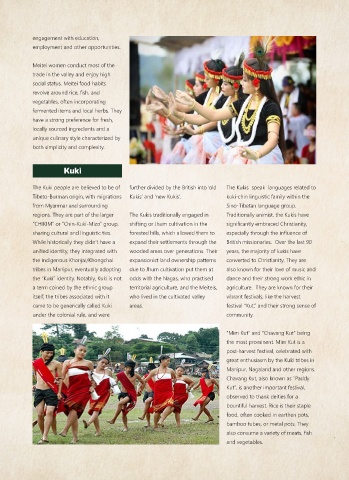
                                                                            “Mim Kut” and “Chavang Kut” being
                                                                            the most prominent. Mim Kut is a
                                                                            post-harvest festival, celebrated with
                                                                            great enthusiasm by the Kuki tribes in
                                                                            Manipur, Nagaland and other regions.
                                                                            Chavang Kut, also known as “Paddy
                                                                            Kut”, is another important festival,
                                                                            observed to thank deities for a
                                                                            bountiful harvest. Rice is their staple
                                                                            food, often cooked in earthen pots,
                                                                            bamboo tubes, or metal pots. They
                                                                            also consume a variety of meats, fish
                                                                            and vegetables.

