


Page 167 - Computer Graphics Handout
P. 167
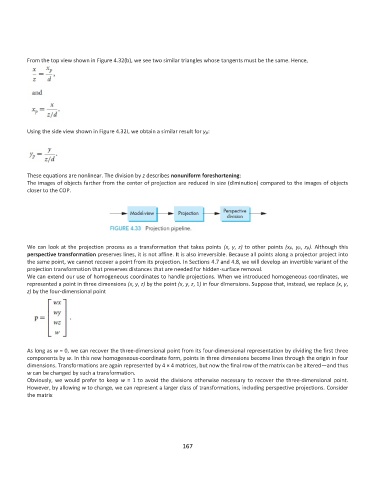
From the top view shown in Figure 4.32(b), we see two similar triangles whose tangents must be the same. Hence,


          Using the side view shown in Figure 4.32I, we obtain a similar result for yp:


          These equations are nonlinear. The division by z describes nonuniform foreshortening:
          The images of objects farther from the center of projection are reduced in size (diminution) compared to the images of objects
          closer to the COP.


          We can look at the projection process as a transformation that takes points (x, y, z) to other points (xp, yp, zp). Although this
          perspective transformation preserves lines, it is not affine. It is also irreversible. Because all points along a projector project into
          the same point, we cannot recover a point from its projection. In Sections 4.7 and 4.8, we will develop an invertible variant of the
          projection transformation that preserves distances that are needed for hidden-surface removal.
          We can extend our use of homogeneous coordinates to handle projections. When we introduced homogeneous coordinates, we
          represented a point in three dimensions (x, y, z) by the point (x, y, z, 1) in four dimensions. Suppose that, instead, we replace (x, y,
          z) by the four-dimensional point


          As long as w = 0, we can recover the three-dimensional point from its four-dimensional representation by dividing the first three
          components by w. In this new homogeneous-coordinate form, points in three dimensions become lines through the origin in four
          dimensions. Transformations are again represented by 4 × 4 matrices, but now the final row of the matrix can be altered—and thus
          w can be changed by such a transformation.
          Obviously, we would prefer to keep  w = 1 to avoid the divisions otherwise necessary to recover the three-dimensional point.
          However, by allowing w to change, we can represent a larger class of transformations, including perspective projections. Consider
          the matrix


                                                             167

