


Page 162 - Computer Graphics Handout
P. 162
4.4.5 Oblique Projections
          Using Ortho, we have only a limited class of parallel projections—namely, only those for which the projectors are orthogonal to the
                                                                                                                  30
          projection  plane.  As  we  saw  earlier  in  this  chapter,  oblique  parallel  projections  are  useful  in  many  fields .


          We could develop an oblique projection matrix directly; instead, however, we follow the process that we used for the general
          orthogonal projection. We convert the desired projection to a canonical orthogonal projection of distorted objects.
          An oblique projection can be characterized by the angle that the projectors make with the projection plane, as shown in Figure 4.27.
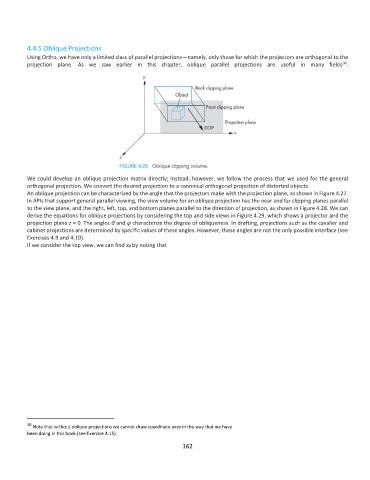
          In APIs that support general parallel viewing, the view volume for an oblique projection has the near and far clipping planes parallel
          to the view plane, and the right, left, top, and bottom planes parallel to the direction of projection, as shown in Figure 4.28. We can
          derive the equations for oblique projections by considering the top and side views in Figure 4.29, which shows a projector and the
          projection plane z = 0. The angles θ and φ characterize the degree of obliqueness. In drafting, projections such as the cavalier and
          cabinet projections are determined by specific values of these angles. However, these angles are not the only possible interface (see
          Exercises 4.9 and 4.10).
          If we consider the top view, we can find xp by noting that


          30
            Note that without oblique projections we cannot draw coordinate axes in the way that we have
          been doing in this book (see Exercise 4.15).
                                                             162

