


Page 158 - Computer Graphics Handout
P. 158
4.4.1 Orthogonal Projections
          Orthogonal or orthographic projections are a special case of parallel projections, in which the projectors are perpendicular to the
          view plane. In terms of a camera, orthogonal projections correspond to a camera with a back plane parallel to the lens, which has
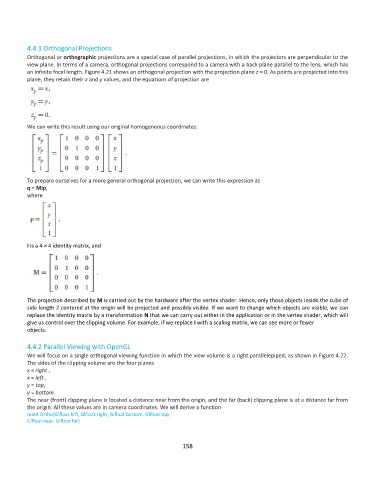
          an infinite focal length. Figure 4.21 shows an orthogonal projection with the projection plane z = 0. As points are projected into this
          plane, they retain their x and y values, and the equations of projection are


          We can write this result using our original homogeneous coordinates:


          To prepare ourselves for a more general orthogonal projection, we can write this expression as
          q = Mip,
          where


          I is a 4 × 4 identity matrix, and


          The projection described by M is carried out by the hardware after the vertex shader. Hence, only those objects inside the cube of
          side length 2 centered at the origin will be projected and possibly visible. If we want to change which objects are visible, we can
          replace the identity matrix by a transformation N that we can carry out either in the application or in the vertex shader, which will
          give us control over the clipping volume. For example, if we replace I with a scaling matrix, we can see more or fewer
          objects.

          4.4.2 Parallel Viewing with OpenGL
          We will focus on a single orthogonal viewing function in which the view volume is a right parallelepiped, as shown in Figure 4.22.
          The sides of the clipping volume are the four planes
          x = right ,
          x = left ,
          y = top,
          y = bottom.
          The near (front) clipping plane is located a distance near from the origin, and the far (back) clipping plane is at a distance far from
          the origin. All these values are in camera coordinates. We will derive a function
          mat4 Ortho(Glfloat left, Glfloat right, Glfloat bottom, Glfloat top,
          Glfloat near, Glfloat far)


                                                             158

