


Page 56 - Computer Graphics Handout
P. 56
wavelengths from about 350 to 780 nm, as shown in Figure 2.24. The value for a given wavelength λ in the visible spectrum gives
          the intensity of that wavelength in the color.
          Although this characterization is accurate in terms of a physical color whose properties we can measure, it does not take into account
          how we perceive color. As noted in Chapter 1, the human visual system has three types of cones responsible for color vision. Hence,
          our brains do not receive the entire distribution C(λ) for a given color but rather three values—the tristimulus values—that are the
          responses of the three types of cones to the color. This reduction of a color to three values leads to the basic tenet of three-color
          theory: If two colors produce the same tristimulus values, then they are visually indistinguishable.
          A consequence of this tenet is that, in principle, a display needs only three primary colors to produce the three tristimulus values
          needed for a human observer. We vary the intensity of each primary to produce a color, as we saw for the CRT in Chapter 1. The
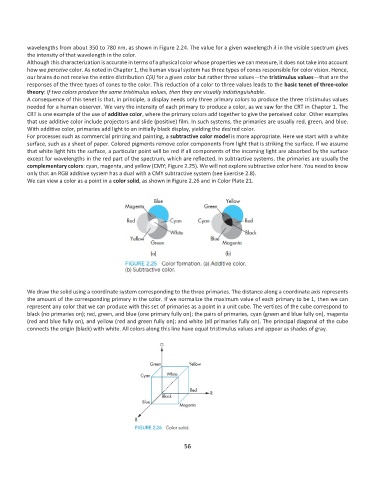
          CRT is one example of the use of additive color, where the primary colors add together to give the perceived color. Other examples
          that use additive color include projectors and slide (positive) film. In such systems, the primaries are usually red, green, and blue.
          With additive color, primaries add light to an initially black display, yielding the desired color.
          For processes such as commercial printing and painting, a subtractive color model is more appropriate. Here we start with a white
          surface, such as a sheet of paper. Colored pigments remove color components from light that is striking the surface. If we assume
          that white light hits the surface, a particular point will be red if all components of the incoming light are absorbed by the surface
          except for wavelengths in the red part of the spectrum, which are reflected. In subtractive systems, the primaries are usually the
          complementary colors: cyan, magenta, and yellow (CMY; Figure 2.25). We will not explore subtractive color here. You need to know
          only that an RGB additive system has a dual with a CMY subtractive system (see Exercise 2.8).
          We can view a color as a point in a color solid, as shown in Figure 2.26 and in Color Plate 21.


          We draw the solid using a coordinate system corresponding to the three primaries. The distance along a coordinate axis represents
          the amount of the corresponding primary in the color. If we normalize the maximum value of each primary to be 1, then we can
          represent any color that we can produce with this set of primaries as a point in a unit cube. The vertices of the cube correspond to
          black (no primaries on); red, green, and blue (one primary fully on); the pairs of primaries, cyan (green and blue fully on), magenta
          (red and blue fully on), and yellow (red and green fully on); and white (all primaries fully on). The principal diagonal of the cube
          connects the origin (black) with white. All colors along this line have equal tristimulus values and appear as shades of gray.


                                                              56

