


Page 55 - Computer Graphics Handout
P. 55
In systems that use immediate-mode graphics and a pipeline architecture, some attributes are part of the state of the graphics
          systems. Hence, there would be a current color that would be used to render all primitives until changed by some state changing
          function such as
          set_current_color(color);
                                                                         10
          Likewise, there would be attribute-setting functions for a variety of attributes . Each  geometric  type  has  a  set  of  attributes.  For
          example, a point has a color attribute and a size attribute. Line segments can have color, thickness, and pattern (solid, dashed, or
          dotted). Filled primitives, such as polygons, have more attributes because we must use multiple parameters to specify how the fill
          should be done. We can fill with a solid color or a pattern. We can decide not to fill the polygon and to display only its edges. If we
          fill the polygon, we might also display the edges in a color different from that of the interior.

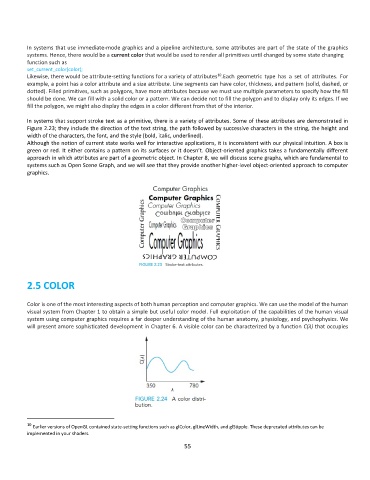
          In systems that support stroke text as a primitive, there is a variety of attributes. Some of these attributes are demonstrated in
          Figure 2.23; they include the direction of the text string, the path followed by successive characters in the string, the height and
          width of the characters, the font, and the style (bold, italic, underlined).
          Although the notion of current state works well for interactive applications, it is inconsistent with our physical intuition. A box is
          green or red. It either contains a pattern on its surfaces or it doesn’t. Object-oriented graphics takes a fundamentally different
          approach in which attributes are part of a geometric object. In Chapter 8, we will discuss scene graphs, which are fundamental to
          systems such as Open Scene Graph, and we will see that they provide another higher-level object-oriented approach to computer
          graphics.


          2.5 COLOR


          Color is one of the most interesting aspects of both human perception and computer graphics. We can use the model of the human
          visual system from Chapter 1 to obtain a simple but useful color model. Full exploitation of the capabilities of the human visual
          system using computer graphics requires a far deeper understanding of the human anatomy, physiology, and psychophysics. We
          will present amore sophisticated development in Chapter 6. A visible color can be characterized by a function C(λ) that occupies


          10
            Earlier versions of OpenGL contained state-setting functions such as glColor, glLineWidth, and glStipple. These deprecated attributes can be
          implemented in your shaders.
                                                              55

