


Page 60 - Computer Graphics Handout
P. 60
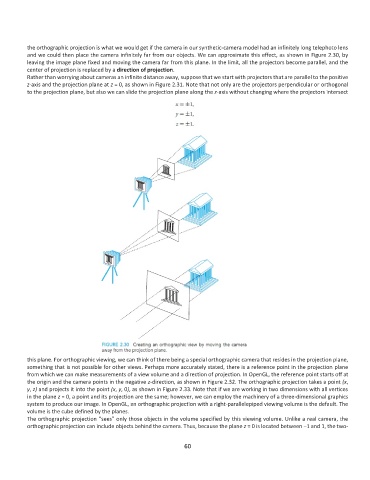
the orthographic projection is what we would get if the camera in our synthetic-camera model had an infinitely long telephoto lens
          and we could then place the camera infinitely far from our objects. We can approximate this effect, as shown in Figure 2.30, by
          leaving the image plane fixed and moving the camera far from this plane. In the limit, all the projectors become parallel, and the
          center of projection is replaced by a direction of projection.
          Rather than worrying about cameras an infinite distance away, suppose that we start with projectors that are parallel to the positive
          z-axis and the projection plane at z = 0, as shown in Figure 2.31. Note that not only are the projectors perpendicular or orthogonal
          to the projection plane, but also we can slide the projection plane along the z-axis without changing where the projectors intersect


          this plane. For orthographic viewing, we can think of there being a special orthographic camera that resides in the projection plane,
          something that is not possible for other views. Perhaps more accurately stated, there is a reference point in the projection plane
          from which we can make measurements of a view volume and a direction of projection. In OpenGL, the reference point starts off at
          the origin and the camera points in the negative z-direction, as shown in Figure 2.32. The orthographic projection takes a point (x,
          y, z) and projects it into the point (x, y, 0), as shown in Figure 2.33. Note that if we are working in two dimensions with all vertices
          in the plane z = 0, a point and its projection are the same; however, we can employ the machinery of a three-dimensional graphics
          system to produce our image. In OpenGL, an orthographic projection with a right-parallelepiped viewing volume is the default. The
          volume is the cube defined by the planes.
          The orthographic projection “sees” only those objects in the volume specified by this viewing volume. Unlike a real camera, the
          orthographic projection can include objects behind the camera. Thus, because the plane z = 0 is located between −1 and 1, the two-


                                                              60

