


Page 197 - Handout of Computer Architecture (1)..
P. 197
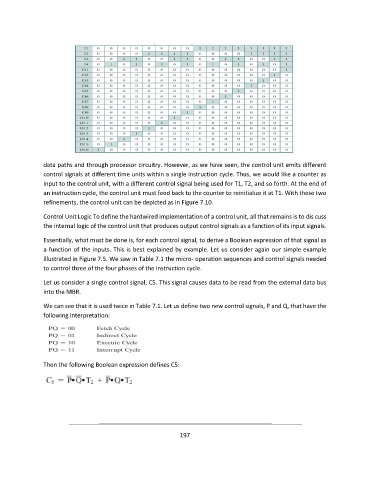
data paths and through processor circuitry. However, as we have seen, the control unit emits different
               control signals at different time units within a single instruction cycle. Thus, we would like a counter as
               input to the control unit, with a different control signal being used for T1, T2, and so forth. At the end of
               an instruction cycle, the control unit must feed back to the counter to reinitialize it at T1. With these two
               refinements, the control unit can be depicted as in Figure 7.10.

               Control Unit Logic To define the hardwired implementation of a control unit, all that remains is to dis cuss
               the internal logic of the control unit that produces output control signals as a function of its input signals.

               Essentially, what must be done is, for each control signal, to derive a Boolean expression of that signal as
               a function of the inputs. This is best explained by example. Let us consider again our simple example
               illustrated in Figure 7.5. We saw in Table 7.1 the micro- operation sequences and control signals needed
               to control three of the four phases of the instruction cycle.

               Let us consider a single control signal, C5. This signal causes data to be read from the external data bus
               into the MBR.
               We can see that it is used twice in Table 7.1. Let us define two new control signals, P and Q, that have the
               following interpretation:


               Then the following Boolean expression defines C5:


                                                             197

