


Page 198 - Handout of Computer Architecture (1)..
P. 198
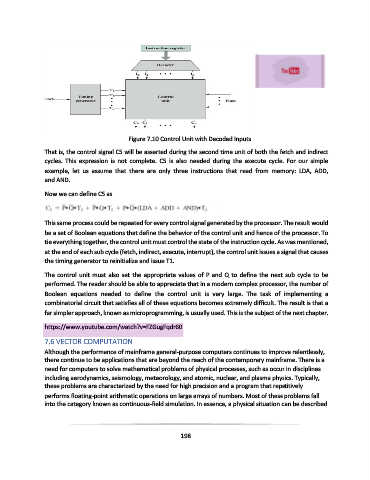
Figure 7.10 Control Unit with Decoded Inputs

               That is, the control signal C5 will be asserted during the second time unit of both the fetch and indirect
               cycles.  This  expression  is  not  complete.  C5  is  also  needed  during  the  execute  cycle.  For  our  simple
               example,  let  us  assume  that  there  are  only  three  instructions  that  read  from  memory:  LDA,  ADD,
               and AND.


               Now we can define C5 as


               This same process could be repeated for every control signal generated by the processor. The result would
               be a set of Boolean equations that define the behavior of the control unit and hence of the processor. To
               tie everything together, the control unit must control the state of the instruction cycle. As was mentioned,
               at the end of each sub cycle (fetch, indirect, execute, interrupt), the control unit issues a signal that causes
               the timing generator to reinitialize and issue T1.

               The control unit must also set the appropriate values of P and Q to define the next  sub cycle to be
               performed. The reader should be able to appreciate that in a modern complex processor, the number of
               Boolean  equations  needed  to  define  the  control  unit  is  very  large.  The  task  of  implementing  a
               combinatorial circuit that satisfies all of these equations becomes extremely difficult. The result is that a
               far simpler approach, known as microprogramming, is usually used. This is the subject of the next chapter.

               https://www.youtube.com/watch?v=FZGugFqdr60

               7.6 VECTOR COMPUTATION
               Although the performance of mainframe general-purpose computers continues to improve relentlessly,
               there continue to be applications that are beyond the reach of the contemporary mainframe. There is a
               need for computers to solve mathematical problems of physical processes, such as occur in disciplines
               including aerodynamics, seismology, meteorology, and atomic, nuclear, and plasma physics. Typically,
               these problems are characterized by the need for high precision and a program that repetitively
               performs floating-point arithmetic operations on large arrays of numbers. Most of these problems fall
               into the category known as continuous-field simulation. In essence, a physical situation can be described


                                                             198

