


Page 202 - Handout of Computer Architecture (1)..
P. 202
the ALU until the entire vector is processed. The pipeline operation can be further enhanced if the
               vector elements are available in registers rather than from main memory. This is in fact suggested by
               Figure 17.16a.

               The elements of each vector operand are loaded as a block into a vector register, which is simply a large
               bank of identical registers. The result is also placed in a vector register. Thus, most operations involve
               only the use of registers, and only load and store operations and the beginning and end of a vector
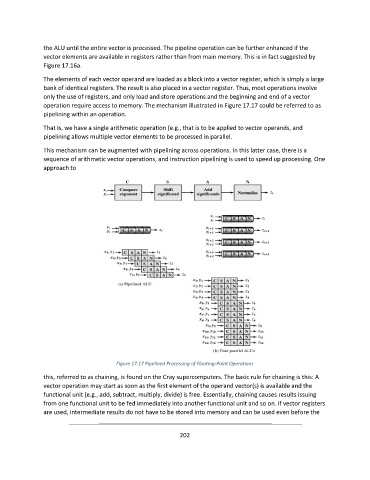
               operation require access to memory. The mechanism illustrated in Figure 17.17 could be referred to as
               pipelining within an operation.

               That is, we have a single arithmetic operation (e.g., that is to be applied to vector operands, and
               pipelining allows multiple vector elements to be processed in parallel.
               This mechanism can be augmented with pipelining across operations. In this latter case, there is a
               sequence of arithmetic vector operations, and instruction pipelining is used to speed up processing. One
               approach to


                                       Figure 17.17 Pipelined Processing of Floating-Point Operations

               this, referred to as chaining, is found on the Cray supercomputers. The basic rule for chaining is this: A
               vector operation may start as soon as the first element of the operand vector(s) is available and the
               functional unit (e.g., add, subtract, multiply, divide) is free. Essentially, chaining causes results issuing
               from one functional unit to be fed immediately into another functional unit and so on. If vector registers
               are used, intermediate results do not have to be stored into memory and can be used even before the


                                                             202

