


Page 200 - Handout of Computer Architecture (1)..
P. 200
can be referred to as vector processing. This assumes that it is possible to operate on a one-dimensional
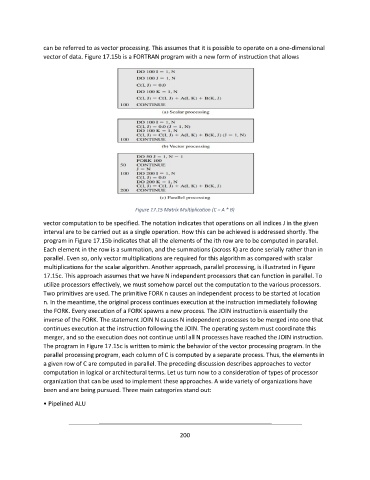
               vector of data. Figure 17.15b is a FORTRAN program with a new form of instruction that allows


                                              Figure 17.15 Matrix Multiplication (C = A * B)
               vector computation to be specified. The notation indicates that operations on all indices J in the given
               interval are to be carried out as a single operation. How this can be achieved is addressed shortly. The
               program in Figure 17.15b indicates that all the elements of the ith row are to be computed in parallel.
               Each element in the row is a summation, and the summations (across K) are done serially rather than in
               parallel. Even so, only vector multiplications are required for this algorithm as compared with scalar
               multiplications for the scalar algorithm. Another approach, parallel processing, is illustrated in Figure
               17.15c. This approach assumes that we have N independent processors that can function in parallel. To
               utilize processors effectively, we must somehow parcel out the computation to the various processors.
               Two primitives are used. The primitive FORK n causes an independent process to be started at location
               n. In the meantime, the original process continues execution at the instruction immediately following
               the FORK. Every execution of a FORK spawns a new process. The JOIN instruction is essentially the
               inverse of the FORK. The statement JOIN N causes N independent processes to be merged into one that
               continues execution at the instruction following the JOIN. The operating system must coordinate this
               merger, and so the execution does not continue until all N processes have reached the JOIN instruction.
               The program in Figure 17.15c is written to mimic the behavior of the vector processing program. In the
               parallel processing program, each column of C is computed by a separate process. Thus, the elements in
               a given row of C are computed in parallel. The preceding discussion describes approaches to vector
               computation in logical or architectural terms. Let us turn now to a consideration of types of processor
               organization that can be used to implement these approaches. A wide variety of organizations have
               been and are being pursued. Three main categories stand out:

               • Pipelined ALU


                                                             200

