


Page 203 - Handout of Computer Architecture (1)..
P. 203
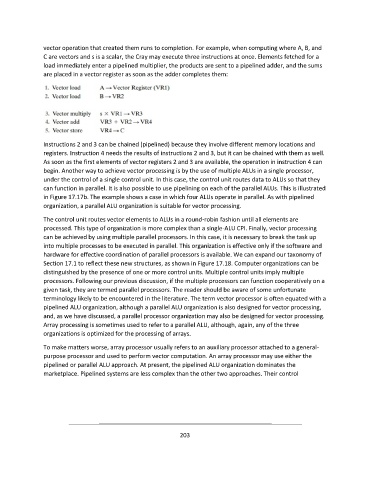
vector operation that created them runs to completion. For example, when computing where A, B, and
               C are vectors and s is a scalar, the Cray may execute three instructions at once. Elements fetched for a
               load immediately enter a pipelined multiplier, the products are sent to a pipelined adder, and the sums
               are placed in a vector register as soon as the adder completes them:


               Instructions 2 and 3 can be chained (pipelined) because they involve different memory locations and
               registers. Instruction 4 needs the results of instructions 2 and 3, but it can be chained with them as well.
               As soon as the first elements of vector registers 2 and 3 are available, the operation in instruction 4 can
               begin. Another way to achieve vector processing is by the use of multiple ALUs in a single processor,
               under the control of a single control unit. In this case, the control unit routes data to ALUs so that they
               can function in parallel. It is also possible to use pipelining on each of the parallel ALUs. This is illustrated
               in Figure 17.17b. The example shows a case in which four ALUs operate in parallel. As with pipelined
               organization, a parallel ALU organization is suitable for vector processing.

               The control unit routes vector elements to ALUs in a round-robin fashion until all elements are
               processed. This type of organization is more complex than a single-ALU CPI. Finally, vector processing
               can be achieved by using multiple parallel processors. In this case, it is necessary to break the task up
               into multiple processes to be executed in parallel. This organization is effective only if the software and
               hardware for effective coordination of parallel processors is available. We can expand our taxonomy of
               Section 17.1 to reflect these new structures, as shown in Figure 17.18. Computer organizations can be
               distinguished by the presence of one or more control units. Multiple control units imply multiple
               processors. Following our previous discussion, if the multiple processors can function cooperatively on a
               given task, they are termed parallel processors. The reader should be aware of some unfortunate
               terminology likely to be encountered in the literature. The term vector processor is often equated with a
               pipelined ALU organization, although a parallel ALU organization is also designed for vector processing,
               and, as we have discussed, a parallel processor organization may also be designed for vector processing.
               Array processing is sometimes used to refer to a parallel ALU, although, again, any of the three
               organizations is optimized for the processing of arrays.

               To make matters worse, array processor usually refers to an auxiliary processor attached to a general-
               purpose processor and used to perform vector computation. An array processor may use either the
               pipelined or parallel ALU approach. At present, the pipelined ALU organization dominates the
               marketplace. Pipelined systems are less complex than the other two approaches. Their control


                                                             203

