


Page 199 - Handout of Computer Architecture (1)..
P. 199
by a surface or region in three dimensions (e.g., the flow of air adjacent to the surface of a rocket).This
               surface is approximated by a grid of points.

               A set of differential equations defines the physical behavior of the surface at each point. The equations
               are represented as an array of values and coefficients, and the solution involves repeated arithmetic
               operations on the arrays of data. Supercomputers were developed to handle these types of problems.
               These machines are typically capable of billions of floating-point operations per second. In contrast to
               mainframes, which are designed for multiprogramming and intensive I/O, the supercomputer is
               optimized for the type of numerical calculation just described. The supercomputer has limited use and,
               because of its price tag, a limited market. Comparatively few of these machines are operational, mostly
               at research centers and some government agencies with scientific or engineering functions. As with
               other areas of computer technology, there is a constant demand to increase the performance of the
               supercomputer. Thus, the technology and performance of the supercomputer continues to evolve.
               There is another type of system that has been designed to address the need for vector computation,
               referred to as the array processor. Although a supercomputer is optimized for vector computation, it is a
               general-purpose computer, capable of handling scalar processing and general data processing tasks.
               Array processors do not include scalar processing; they are configured as peripheral devices by both
               mainframe and minicomputer users to run the vectorized portions of programs.

               7.8 Approaches to Vector Computation
               The key to the design of a supercomputer or array processor is to recognize that the main task is to
               perform arithmetic operations on arrays or vectors of floating-point numbers. In a general-purpose
               computer, this will require iteration through each element of the array. For example, consider two
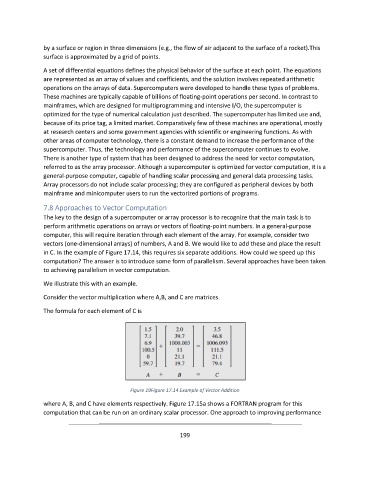
               vectors (one-dimensional arrays) of numbers, A and B. We would like to add these and place the result
               in C. In the example of Figure 17.14, this requires six separate additions. How could we speed up this
               computation? The answer is to introduce some form of parallelism. Several approaches have been taken
               to achieving parallelism in vector computation.

               We illustrate this with an example.

               Consider the vector multiplication where A,B, and C are matrices.

               The formula for each element of C is


                                            Figure 19Figure 17.14 Example of Vector Addition

               where A, B, and C have elements respectively. Figure 17.15a shows a FORTRAN program for this
               computation that can be run on an ordinary scalar processor. One approach to improving performance


                                                             199

