


Page 95 - Analytical Chemistry I E-book
P. 95
Solvents for Non-Aqueous Titrations

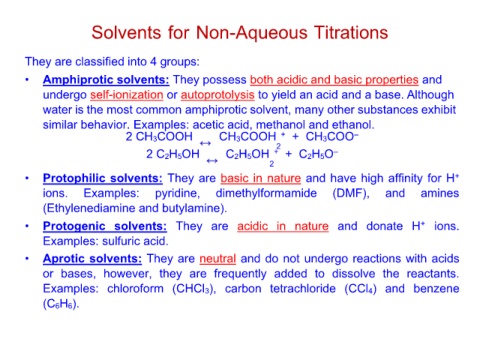
They are classified into 4 groups:

• Amphiprotic solvents: They possess both acidic and basic properties and

undergo self-ionization or autoprotolysis to yield an acid and a base. Although

water is the most common amphiprotic solvent, many other substances exhibit

similar behavior. Examples: acetic acid, methanol and ethanol.
2 CH3COOH CH3COOH + + CH3COO–
                                    C2H5OH +2 + C2H5O–
2 C2H5OH                            2

• Protophilic solvents: They are basic in nature and have high affinity for H+

ions. Examples: pyridine, dimethylformamide (DMF), and amines

(Ethylenediamine and butylamine).

• Protogenic solvents: They are acidic in nature and donate H+ ions.
    Examples: sulfuric acid.

• Aprotic solvents: They are neutral and do not undergo reactions with acids
    or bases, however, they are frequently added to dissolve the reactants.
    Examples: chloroform (CHCl3), carbon tetrachloride (CCl4) and benzene
    (C6H6).

