


Page 48 - 02ELA Y2 SPR guide_Neat
P. 48
Overview of Y2 Spring Term Part 1
2. They should be reminded that God loves and values every person.
3. They should not despise other people but love and respect them.
HOMOPHONES - SAME SOUND, DIFFERENT FUNCTION
Truth to Teach (Source)
Each person has been created unique, but yet each is uniquely suited to fit into
God’s overall plan.
To distinguish between the homophones – to, two and too
Way to Work (Means)
1. Refer to brothers and sisters in a family whose voices sound alike. Sometimes it is
difficult to tell them apart just by listening to them. Each however is a different
person who has been created by God and he can distinguish each person’s voice
when he/she prays. He also has a unique plan for each person’s life.
2. Today we are going to meet three words, which sound the same but which have a
different part to play in a sentence.
Write to, two and too on the board. Say one of these and ask the children to guess
which one it is. Establish that the words cannot be identified by sound. These words
are called ‘homophones’. ‘Homo’ means ‘the same’ and ‘phone’ means ‘sound’, i.e. they
sound the same, but are different.
3. Talk about the need to spell each one correctly when writing them.
4. Go through each word in turn – see below.
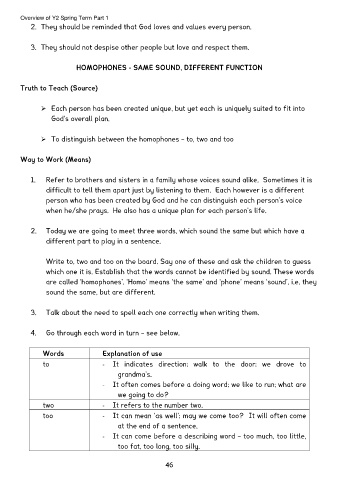
Words Explanation of use
to - It indicates direction; walk to the door; we drove to
grandma’s.
- It often comes before a doing word; we like to run; what are
we going to do?
two - It refers to the number two.
too - It can mean ‘as well’; may we come too? It will often come
at the end of a sentence.
- It can come before a describing word – too much, too little,
too fat, too long, too silly.
46

