


Page 1121 - Basic Electrical Engineering
P. 1121
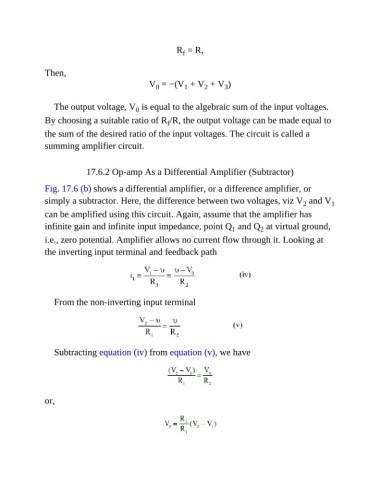
R  = R,
                                                            f


               Then,
                                                 V  = −(V  + V  + V )
                                                   0
                                                                   2
                                                            1
                                                                         3
                  The output voltage, V  is equal to the algebraic sum of the input voltages.
                                             0
               By choosing a suitable ratio of R /R, the output voltage can be made equal to
                                                       f
               the sum of the desired ratio of the input voltages. The circuit is called a

               summing amplifier circuit.


                             17.6.2 Op-amp As a Differential Amplifier (Subtractor)

               Fig. 17.6 (b) shows a differential amplifier, or a difference amplifier, or

               simply a subtractor. Here, the difference between two voltages, viz V  and V                 1
                                                                                                   2
               can be amplified using this circuit. Again, assume that the amplifier has

               infinite gain and infinite input impedance, point Q  and Q  at virtual ground,
                                                                            1
                                                                                     2
               i.e., zero potential. Amplifier allows no current flow through it. Looking at
               the inverting input terminal and feedback path


                  From the non-inverting input terminal


                  Subtracting equation (iv) from equation (v), we have


               or,

