


Page 18 - textbook5chapters
P. 18
Surgical Anatomy in Pelvic Gynaecologic Oncology 1039

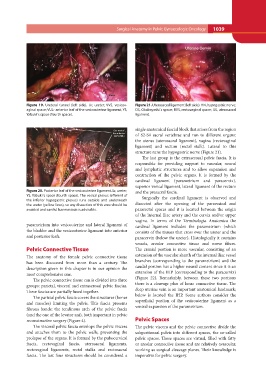
Figure 19. Ureteral tunnel (left side). Ur, ureter; VVS, vesicov-    Figure 21. Uterosacral ligament (left side). HN, hypogastric nerve;
aginal space; VUL- anterior leaf of the vesicouterine ligament; YS,  OS, Okabayashi´s space; RVS, rectovaginal space; US, uterosacral
Yabuki´s space (fourth space).                                       ligament.

Figure 20. Posterior leaf of the vesicouterine ligament.Ur, ureter;  single anatomical fascial block that arises from the region
YS, Yabuki´s space (fourth space). The vesical plexus (efferent of   of S2-S4 sacral vertebrae and run to different organs:
the inferior hypogastric plexus) runs outside and underneath         the uterus (uterosacral ligament), vagina (rectovaginal
the ureter (yellow lines), so any dissection of this area should be  ligament) and rectum (rectal stalk). Lateral to this
avoided and careful haemostasis is advisable.                        structure runs the hypogastric nerve (Figure 21).

parametrium into vesicouterine and lateral ligament of                   The last group is the extraserosal pelvic fascia. It is
the bladder and the vesicouterine ligament into anterior             responsible for providing support to vascular, neural
and posterior leafs.                                                 and lymphatic structures and to allow expansion and
                                                                     contraction of the pelvic organs. It is formed by the
Pelvic Connective Tissue                                             cardinal ligament (parametrium and paracervix),
                                                                     superior vesical ligament, lateral ligament of the rectum
The anatomy of the female pelvic connective tissue                   and the presacral fascia.
has been discussed from more than a century. The
description given in this chapter is in our opinion the                  Surgically the cardinal ligament is observed and
most comprehensive one.                                              dissected after the opening of the paravesical and
                                                                     pararectal spaces and it is located between the origin
    The pelvic connective tissue can is divided into three           of the internal iliac artery and the cervix and/or upper
groups: parietal, visceral and extraserosal pelvic fascias.          vagina. In terms of the Terminologia Anatomica the
These fascias are partially fused together.                          cardinal ligament includes the parametrium (which
                                                                     consists of the tissues that cross over the ureter and the
    The parietal pelvic fascia covers the structures (bones          paracervix (below the ureter). Histologically it contains
and muscles) limiting the pelvis. This fascia presents               vessels, areolar connective tissue and nerve fibers.
fibrous bands: the tendinous arch of the pelvic fascia               The cranial portion is more vascular, consisting of an
(and the one of the levator ani), both important in pelvic           extension of the vascular sheath of the internal iliac vessel
reconstructive surgery (Figure 4).                                   branches (corresponding to the parametrium) and the
                                                                     caudal portion has a higher neural content since it is an
    The visceral pelvic fascia envelops the pelvic viscera           extension of the IHP (corresponding to the paracervix)
and attaches them to the pelvic walls, preventing the                (Figure 22). Remarkably, between these two portions
prolapse of the organs. It is formed by the pubocervical             there is a cleavage plan of loose connective tissue. The
fascia, rectovaginal fascia, uterosacral ligaments,                  deep uterine vein is an important anatomical landmark;
rectovaginal ligaments, rectal stalks and rectosacral                below is located the IHP. Some authors consider the
fascia. The last four structures should be considered a              superficial portion of the vesicouterine ligament as a
                                                                     ventral expansion of the parametrium.

                                                                     Pelvic Spaces

                                                                     The pelvic viscera and the pelvic connective divide the
                                                                     subperitoneal pelvis into different spaces, the so-called
                                                                     pelvic spaces. These spaces are virtual, filled with fatty
                                                                     or areolar connective tissue and are relatively avascular,
                                                                     working as surgical cleavage planes. Their knowledge is
                                                                     imperative for pelvic surgery.

