


Page 116 - Computer Graphics Handout
P. 116
.
          We expand this form to three dimensions in Section 3.9. Note three features of this transformation that extend to other rotations:
          1.  There  is  one  point—the  origin,  in  this  case—that  is  unchanged  by  the  rotation.  We  call  this  point  the  fixed  point  of  the
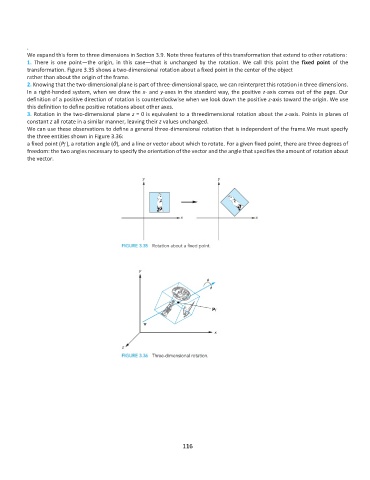
          transformation. Figure 3.35 shows a two-dimensional rotation about a fixed point in the center of the object
          rather than about the origin of the frame.
          2. Knowing that the two-dimensional plane is part of three-dimensional space, we can reinterpret this rotation in three dimensions.
          In a right-handed system, when we draw the x- and y-axes in the standard way, the positive z-axis comes out of the page. Our
          definition of a positive direction of rotation is counterclockwise when we look down the positive z-axis toward the origin. We use
          this definition to define positive rotations about other axes.
          3. Rotation in the two-dimensional plane z = 0 is equivalent to a threedimensional rotation about the z-axis. Points in planes of
          constant z all rotate in a similar manner, leaving their z values unchanged.
          We can use these observations to define a general three-dimensional rotation that is independent of the frame.We must specify
          the three entities shown in Figure 3.36:
          a fixed point (Pf ), a rotation angle (θ), and a line or vector about which to rotate. For a given fixed point, there are three degrees of
          freedom: the two angles necessary to specify the orientation of the vector and the angle that specifies the amount of rotation about
          the vector.


                                                             116

