


Page 119 - Computer Graphics Handout
P. 119
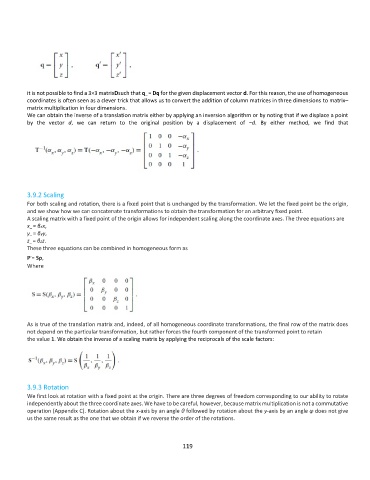
it is not possible to find a 3×3 matrixDsuch that q_ = Dq for the given displacement vector d. For this reason, the use of homogeneous
          coordinates is often seen as a clever trick that allows us to convert the addition of column matrices in three dimensions to matrix–
          matrix multiplication in four dimensions.
          We can obtain the inverse of a translation matrix either by applying an inversion algorithm or by noting that if we displace a point
          by  the  vector  d,  we  can  return  to  the  original  position  by  a  displacement  of  −d.  By  either  method,  we  find  that


          3.9.2 Scaling
          For both scaling and rotation, there is a fixed point that is unchanged by the transformation. We let the fixed point be the origin,
          and we show how we can concatenate transformations to obtain the transformation for an arbitrary fixed point.
          A scaling matrix with a fixed point of the origin allows for independent scaling along the coordinate axes. The three equations are
          x_ = βxx,
          y_ = βyy,
          z_ = βzz.
          These three equations can be combined in homogeneous form as
           ,
          P = Sp,
          Where


          As is true of the translation matrix and, indeed, of all homogeneous coordinate transformations, the final row of the matrix does
          not depend on the particular transformation, but rather forces the fourth component of the transformed point to retain
          the value 1. We obtain the inverse of a scaling matrix by applying the reciprocals of the scale factors:


          3.9.3 Rotation
          We first look at rotation with a fixed point at the origin. There are three degrees of freedom corresponding to our ability to rotate
          independently about the three coordinate axes. We have to be careful, however, because matrix multiplication is not a commutative
          operation (Appendix C). Rotation about the x-axis by an angle θ followed by rotation about the y-axis by an angle φ does not give
          us the same result as the one that we obtain if we reverse the order of the rotations.


                                                             119

