


Page 120 - Computer Graphics Handout
P. 120
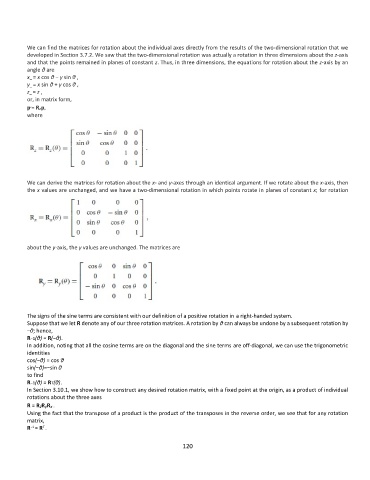
We can find the matrices for rotation about the individual axes directly from the results of the two-dimensional rotation that we
          developed in Section 3.7.2. We saw that the two-dimensional rotation was actually a rotation in three dimensions about the z-axis
          and that the points remained in planes of constant z. Thus, in three dimensions, the equations for rotation about the z-axis by an
          angle θ are
          x_ = x cos θ − y sin θ ,
          y_ = x sin θ + y cos θ ,
          z_ = z ,
          or, in matrix form,
           ,
          p = Rzp,
          where


          We can derive the matrices for rotation about the x- and y-axes through an identical argument. If we rotate about the x-axis, then
          the x values are unchanged, and we have a two-dimensional rotation in which points rotate in planes of constant x; for rotation


          about the y-axis, the y values are unchanged. The matrices are


          The signs of the sine terms are consistent with our definition of a positive rotation in a right-handed system.
          Suppose that we let R denote any of our three rotation matrices. A rotation by θ can always be undone by a subsequent rotation by
          −θ; hence,
          R−1(θ) = R(−θ).
          In addition, noting that all the cosine terms are on the diagonal and the sine terms are off-diagonal, we can use the trigonometric
          identities
          cos(−θ) = cos θ
          sin(−θ)=−sin θ
          to find
          R−1(θ) = RT(θ).
          In Section 3.10.1, we show how to construct any desired rotation matrix, with a fixed point at the origin, as a product of individual
          rotations about the three axes
          R = RzRyRx .
          Using the fact that the transpose of a product is the product of the transposes in the reverse order, we see that for any rotation
          matrix,
               T
          R = R .
           −1
                                                             120

