


Page 121 - Computer Graphics Handout
P. 121
A matrix whose inverse is equal to its transpose is called an orthogonal matrix. Normalized orthogonal matrices correspond to
          rotations about the origin.
          3.9.4 Shear
          Although we can construct any affine transformation from a sequence of rotations, translations, and scalings, there is one more
          affine transformation—the shear transformation—that is of such importance that we regard it as a basic type rather than deriving
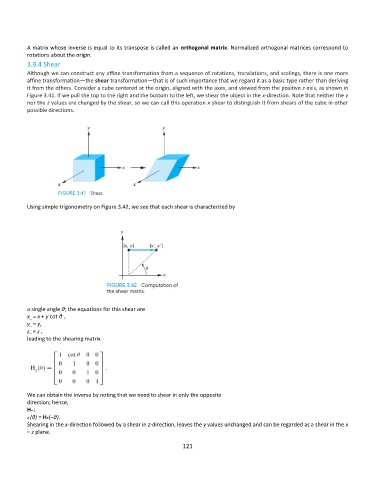
          it from the others. Consider a cube centered at the origin, aligned with the axes, and viewed from the positive z-axis, as shown in
          Figure 3.41. If we pull the top to the right and the bottom to the left, we shear the object in the x-direction. Note that neither the y
          nor the z values are changed by the shear, so we can call this operation x shear to distinguish it from shears of the cube in other
          possible directions.


          Using simple trigonometry on Figure 3.42, we see that each shear is characterized by


          a single angle θ; the equations for this shear are
          x_ = x + y cot θ ,
          y_ = y,
          z_ = z ,
          leading to the shearing matrix


          We can obtain the inverse by noting that we need to shear in only the opposite
          direction; hence,
          H−1
          x (θ) = Hx(−θ).
          Shearing in the x-direction followed by a shear in z-direction, leaves the y values unchanged and can be regarded as a shear in the x
          − z plane.

                                                             121

