


Page 117 - Computer Graphics Handout
P. 117
Rotation and translation are known as rigid-body transformations. No combination of rotations and translations can alter the shape
          or volume of an object; they can alter only the object’s location and orientation. Consequently, rotation and translation alone cannot
          give  us  all  possible  affine  transformations.  The  transformations  shown  in  Figure  3.37  are  affine,  but  they  are  not  rigid-body
          transformations.

          3.8.3 Scaling
          Scaling is an affine non–rigid-body transformation by which we can make an object bigger or smaller. Figure 3.38 illustrates both
          uniform scaling in all directions and scaling in a single direction. We need nonuniform scaling to  build up the full set of affine
          transformations that we use in modeling and viewing by combining a properly
          chosen sequence of scalings, translations, and rotations.


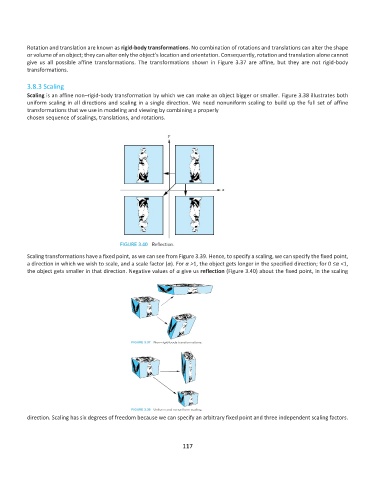
          Scaling transformations have a fixed point, as we can see from Figure 3.39. Hence, to specify a scaling, we can specify the fixed point,
          a direction in which we wish to scale, and a scale factor (α). For α >1, the object gets longer in the specified direction; for 0 ≤α <1,
          the object gets smaller in that direction. Negative values of α give us reflection (Figure 3.40) about the fixed point, in the scaling


          direction. Scaling has six degrees of freedom because we can specify an arbitrary fixed point and three independent scaling factors.


                                                             117

