


Page 118 - Computer Graphics Handout
P. 118
3.9 TRANSFORMATIONS IN HOMOGENEOUS COORDINATES


          All graphics APIs force us to work within some reference system. Hence, we cannot work with high-level expressions such as
          Q = P + αv.
          Instead, we work with representations in homogeneous coordinates and with expressions such as
          q = p + αv.
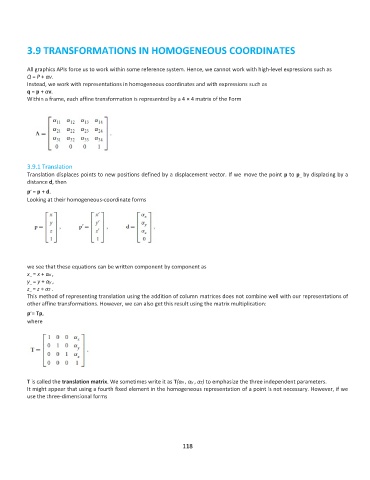
          Within a frame, each affine transformation is represented by a 4 × 4 matrix of the Form


          3.9.1 Translation
          Translation displaces points to new positions defined by a displacement vector. If we move the point p to p_ by displacing by a
          distance d, then
           ,
          p  = p + d.
          Looking at their homogeneous-coordinate forms


          we see that these equations can be written component by component as
          x_ = x + αx ,
          y_ = y + αy ,
          z_ = z + αz .
          This method of representing translation using the addition of column matrices does not combine well with our representations of
          other affine transformations. However, we can also get this result using the matrix multiplication:
           ,
          p = Tp,
          where


          T is called the translation matrix. We sometimes write it as T(αx , αy , αz) to emphasize the three independent parameters.
          It might appear that using a fourth fixed element in the homogeneous representation of a point is not necessary. However, if we
          use the three-dimensional forms


                                                             118

