


Page 133 - phytochemistry I - PharmD Clinical
P. 133
Coumarin (2H-chromen-2-one) (benzo α-pyrone) is an aromatic organic
chemical compound in the benzopyrone chemical class, although it may
also be seen as a subclass of lactones. It is widely distributed within the
Rutaceae and Apiaceae (Umbelliferae) families.

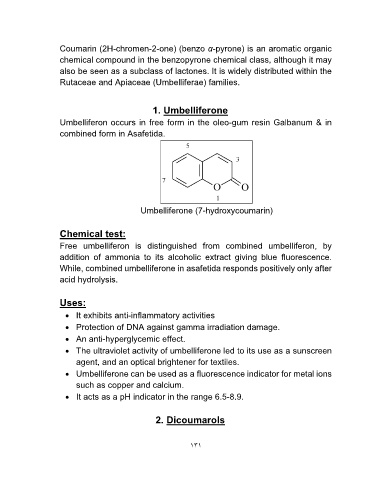
                             1. Umbelliferone

Umbelliferon occurs in free form in the oleo-gum resin Galbanum & in
combined form in Asafetida.

                            Umbelliferone (7-hydroxycoumarin)

Chemical test:

Free umbelliferon is distinguished from combined umbelliferon, by
addition of ammonia to its alcoholic extract giving blue fluorescence.
While, combined umbelliferone in asafetida responds positively only after
acid hydrolysis.

Uses:

 • It exhibits anti-inflammatory activities
 • Protection of DNA against gamma irradiation damage.
 • An anti-hyperglycemic effect.
 • The ultraviolet activity of umbelliferone led to its use as a sunscreen

     agent, and an optical brightener for textiles.
 • Umbelliferone can be used as a fluorescence indicator for metal ions

     such as copper and calcium.
 • It acts as a pH indicator in the range 6.5-8.9.

                              2. Dicoumarols

                                                      ۱۳۱

